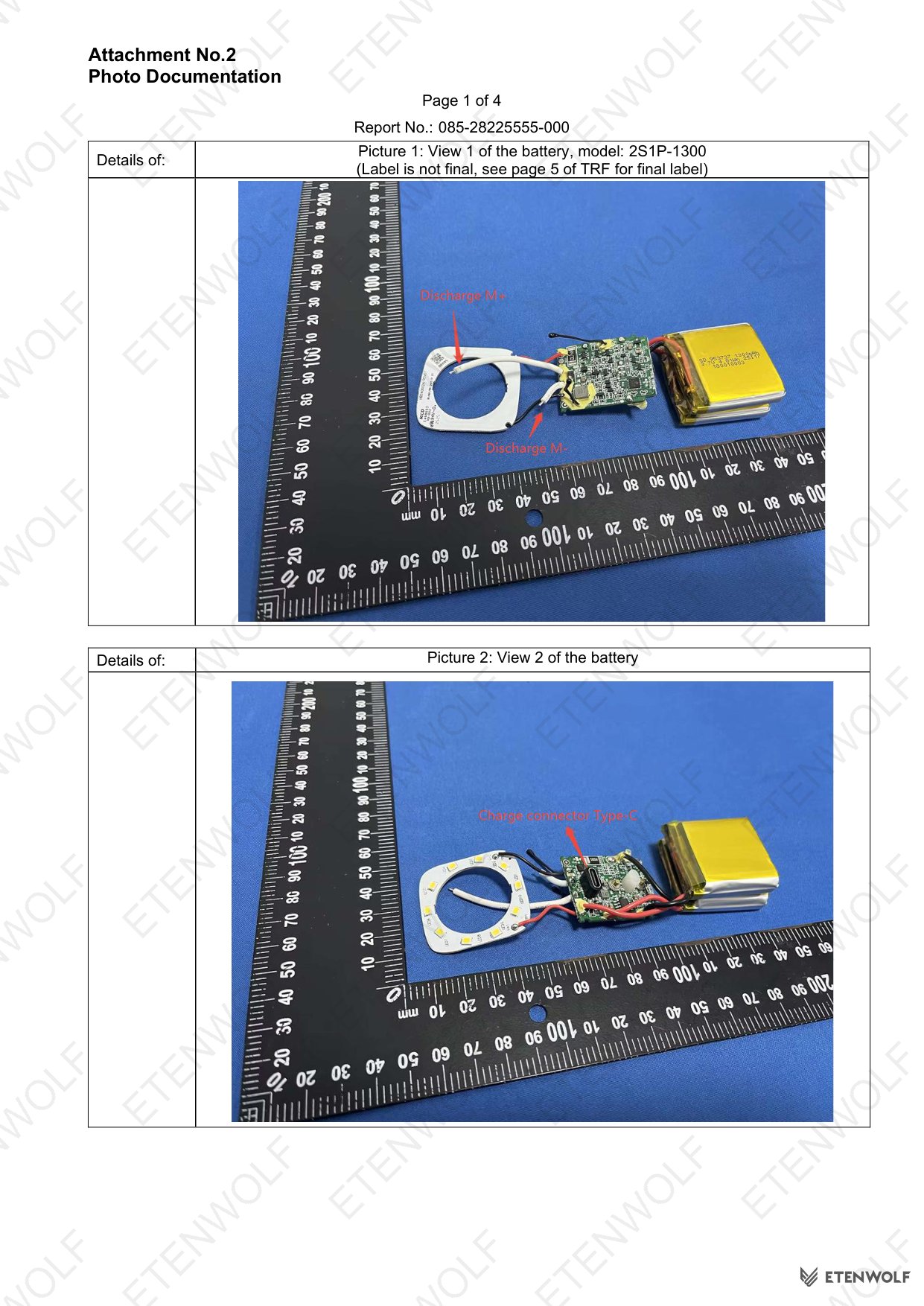
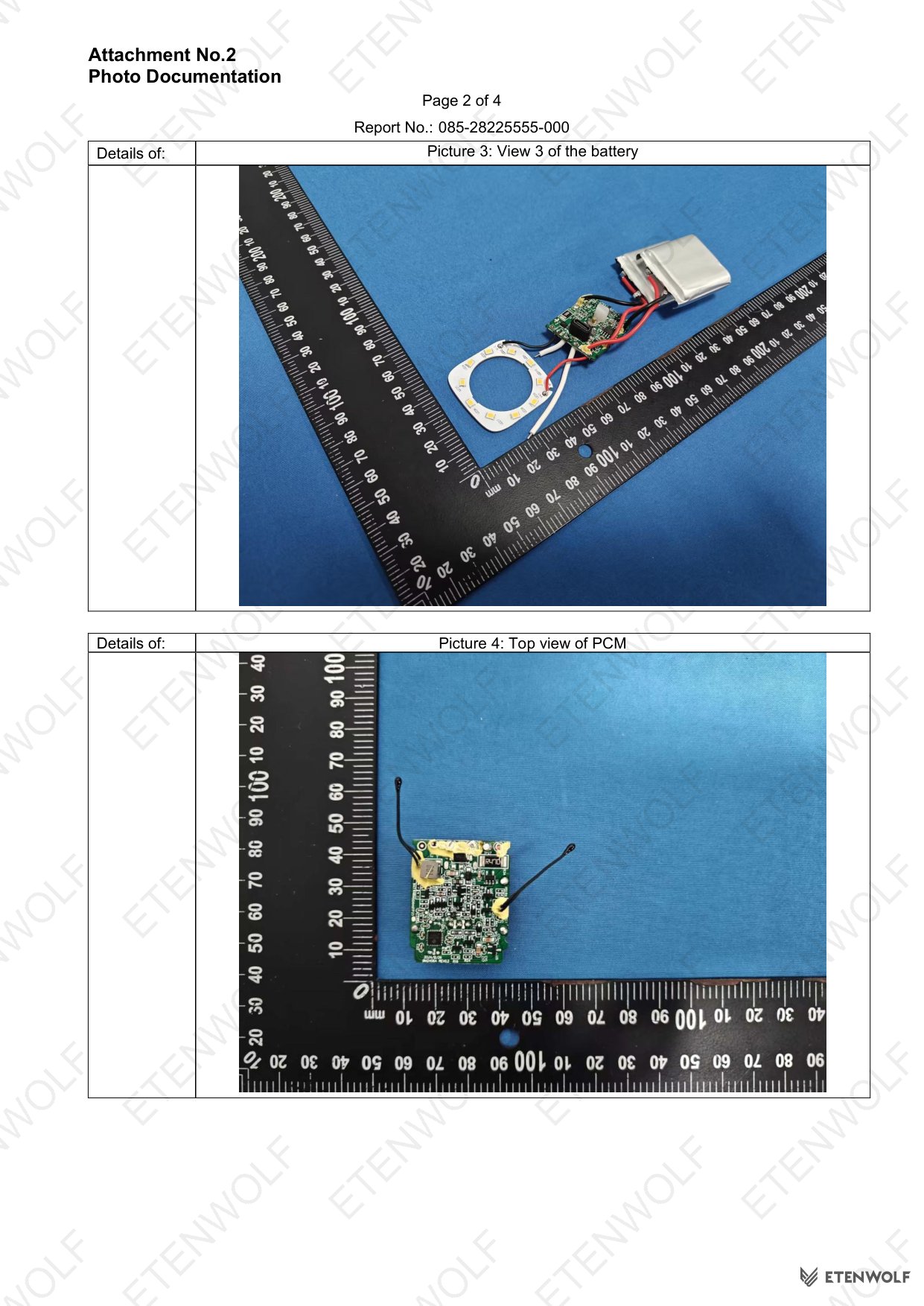
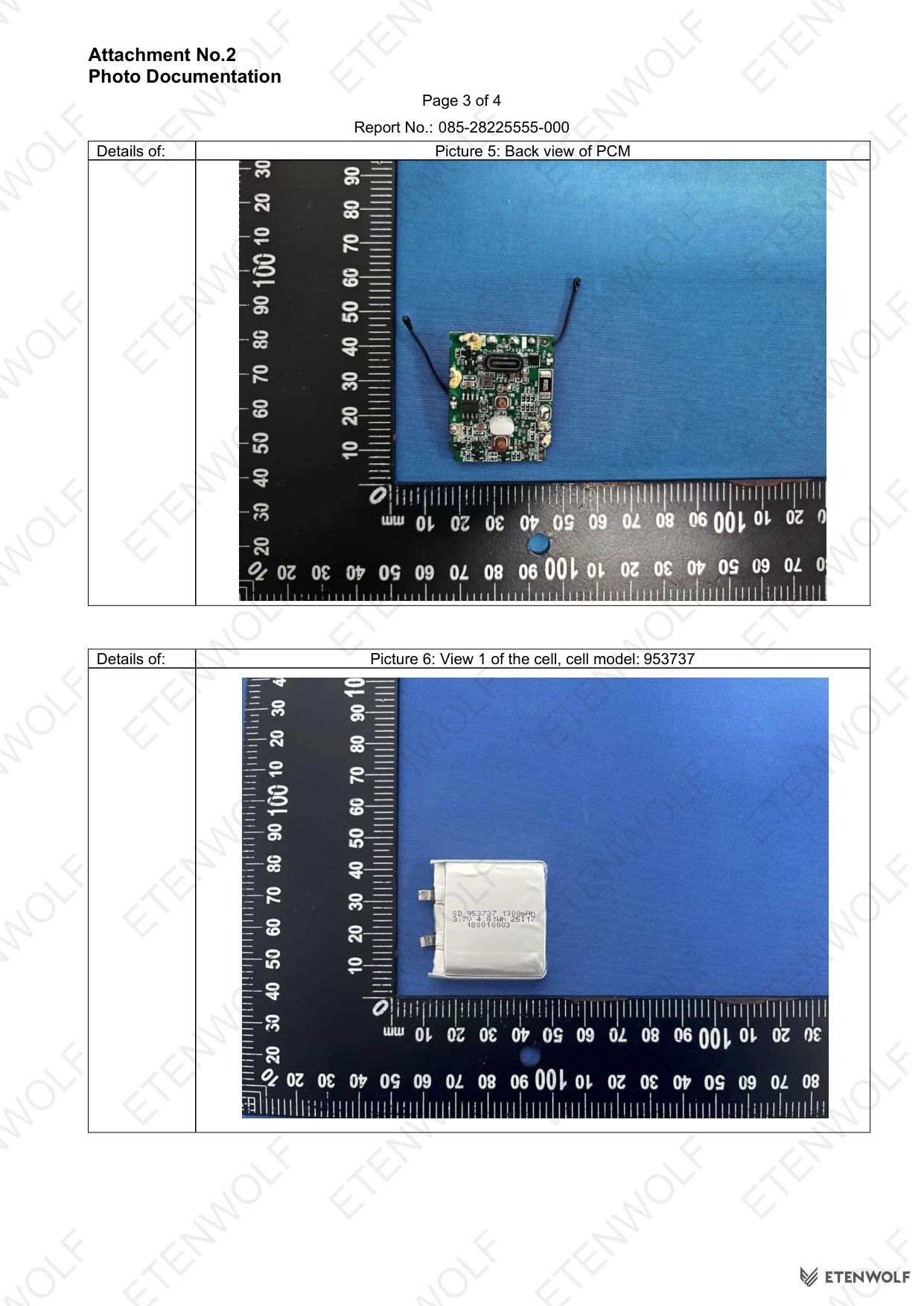
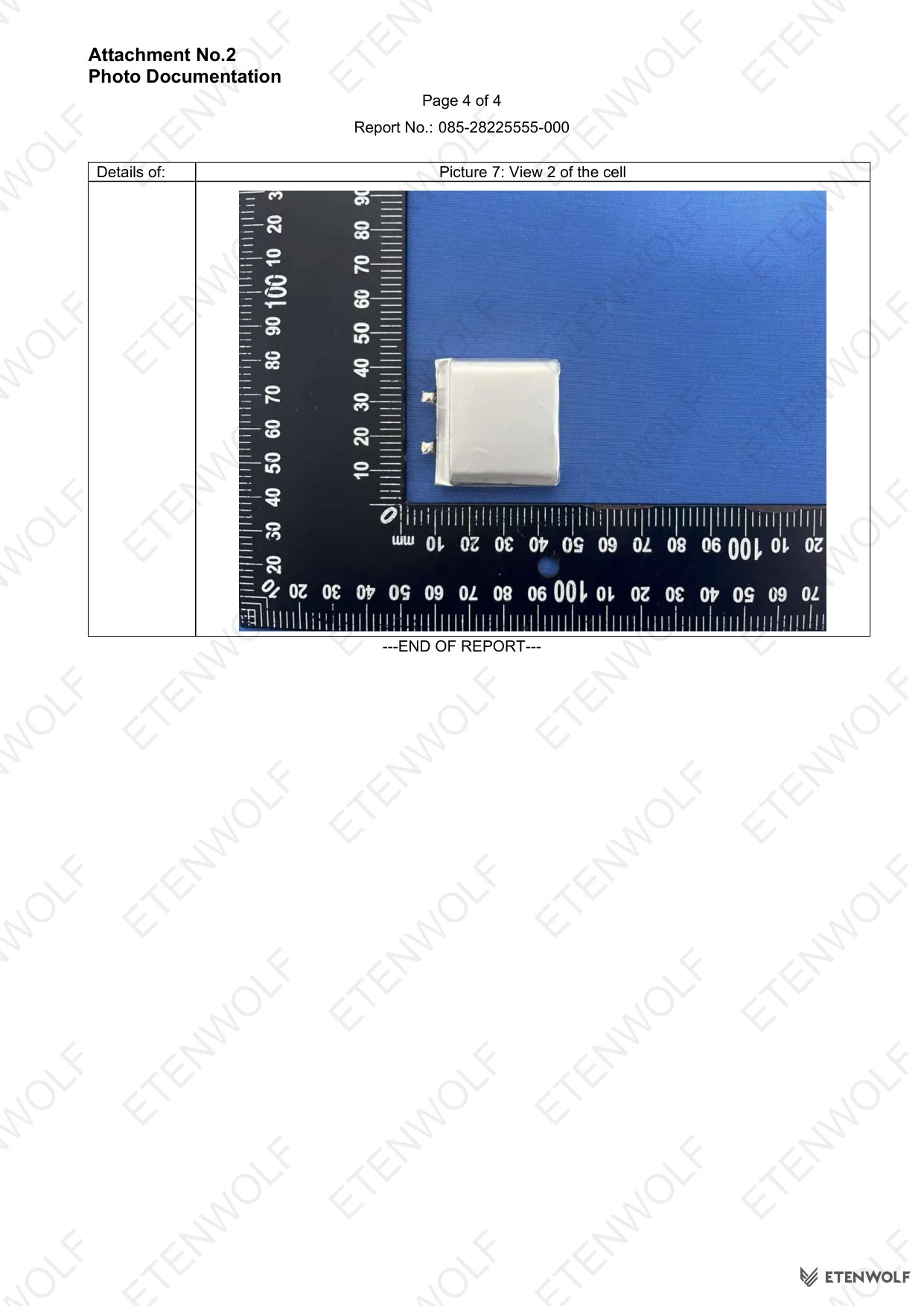
Answer first
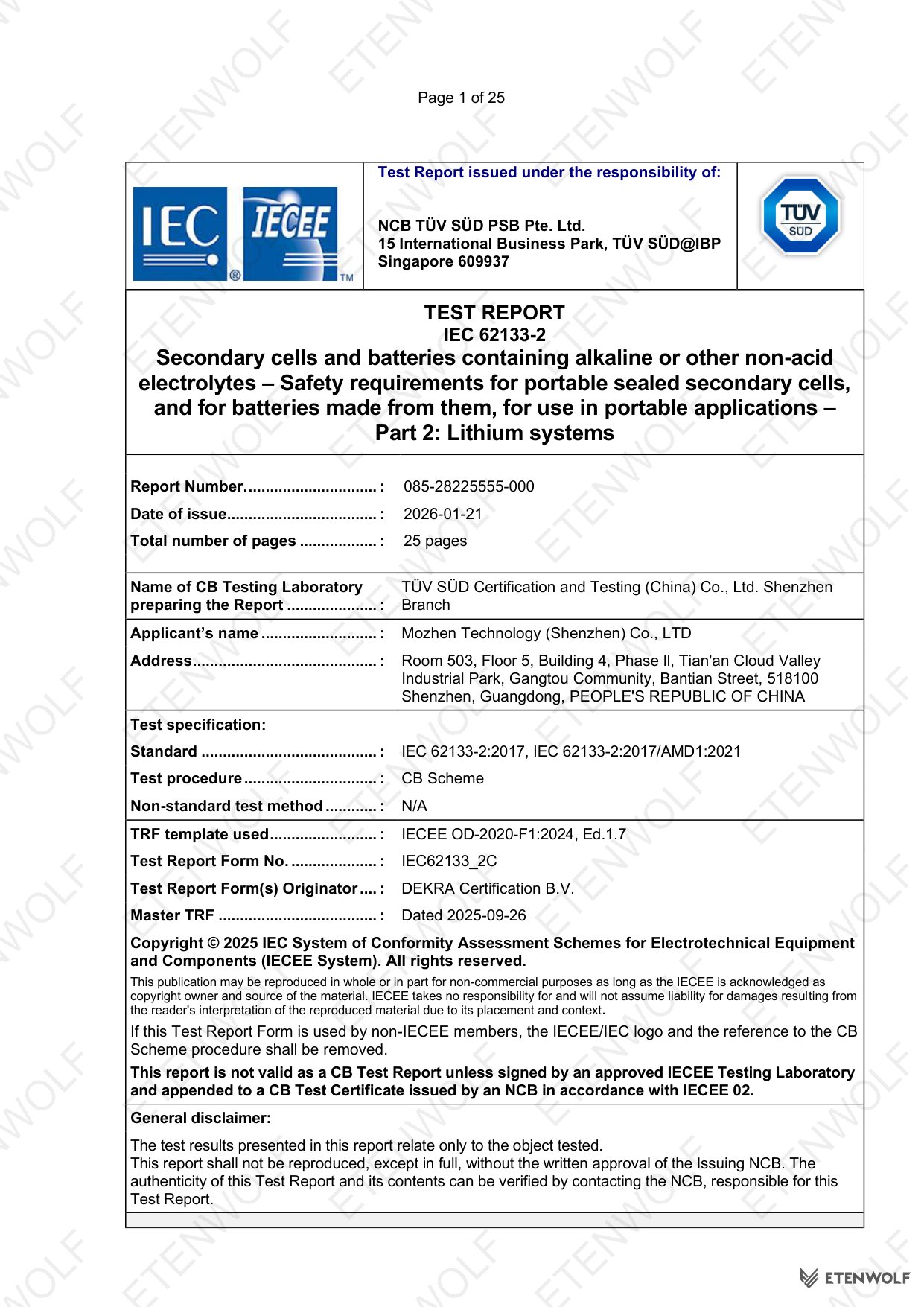
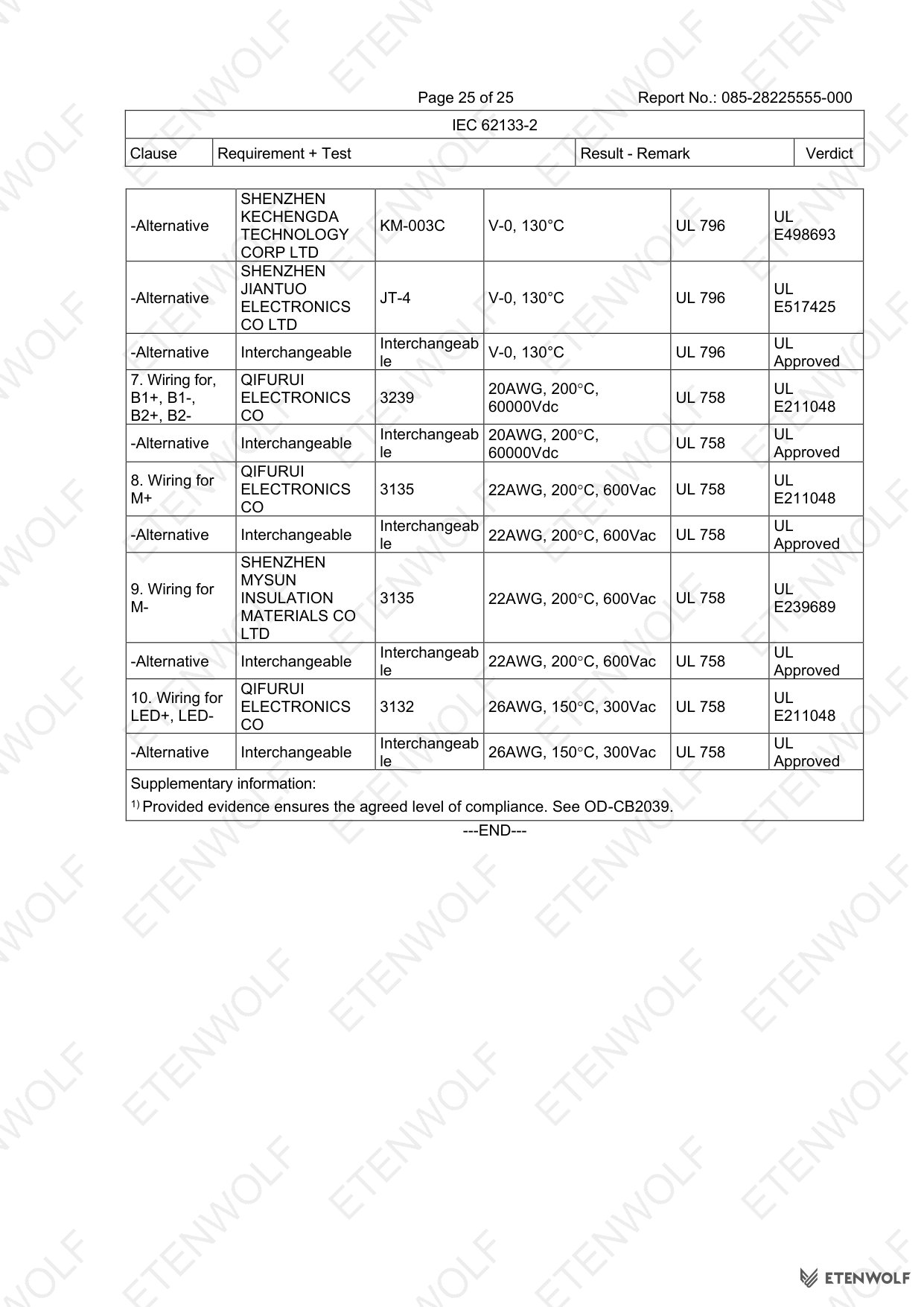
The report verifies the safety test performance of the ETENWOLF Air3 battery pack identified as 2S1P-1300: 7.4 V nominal, 1300 mAh, two cells in series and one parallel string. Report 085-28225555-000 was issued on 21 January 2026 under the IECEE CB Scheme, using IEC 62133-2:2017 and IEC 62133-2:2017/AMD1:2021.
Who tested it?
- Issuing NCB: TÜV SÜD PSB Pte. Ltd., Singapore.
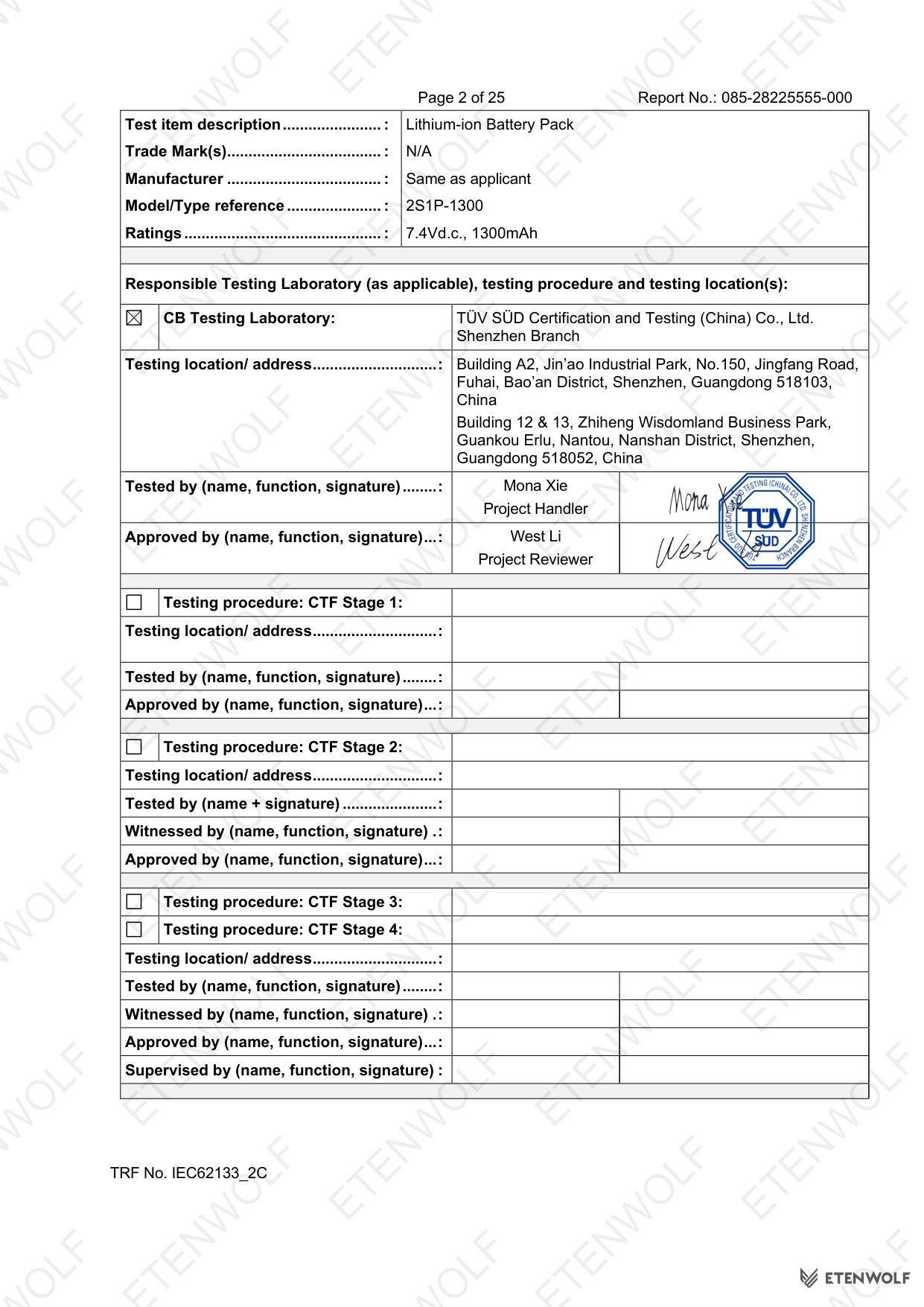
- Testing laboratory: TÜV SÜD Certification and Testing (China) Co., Ltd., Shenzhen Branch.
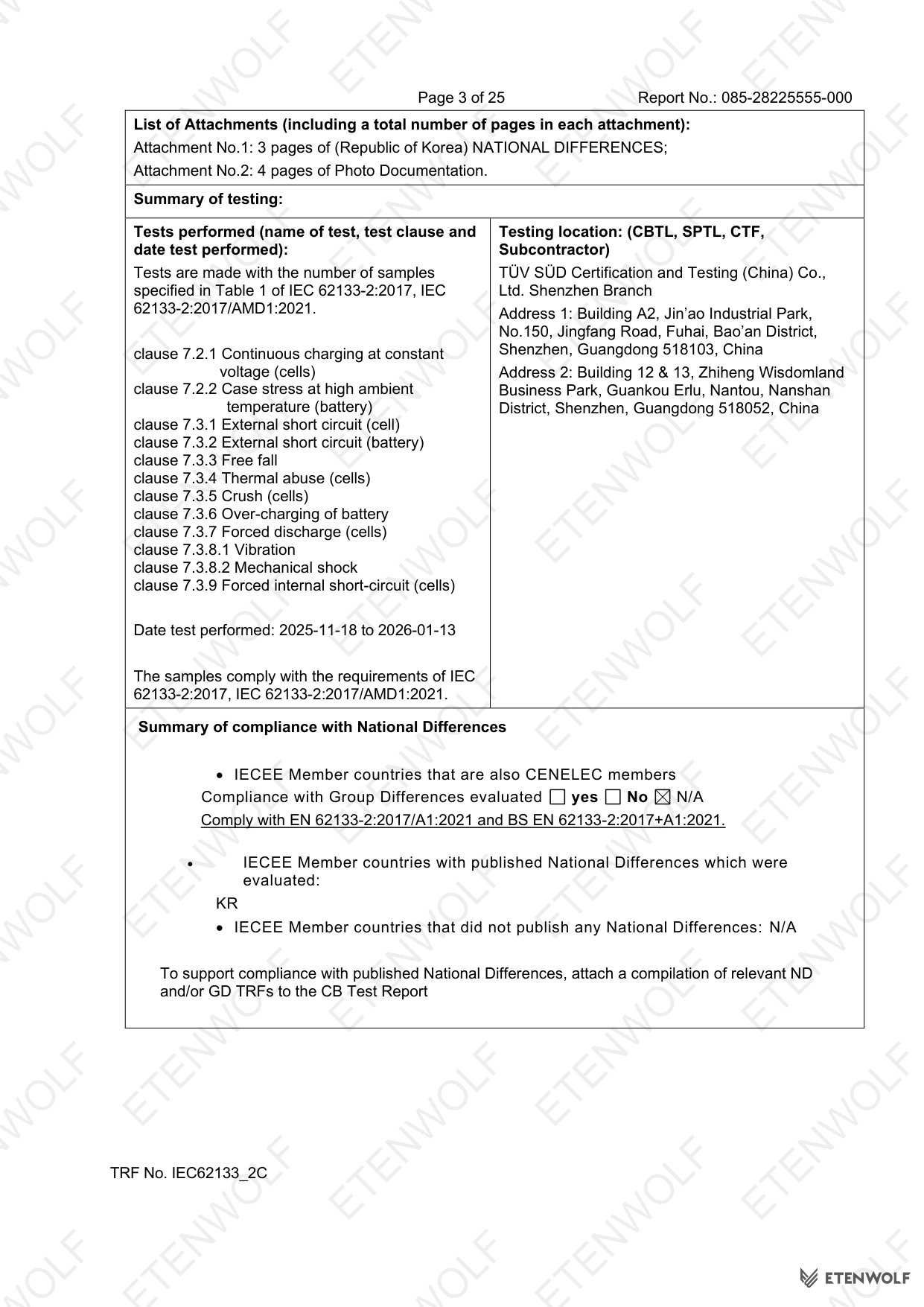
- Testing period: 18 November 2025 to 13 January 2026.
- Report length: 25 pages.
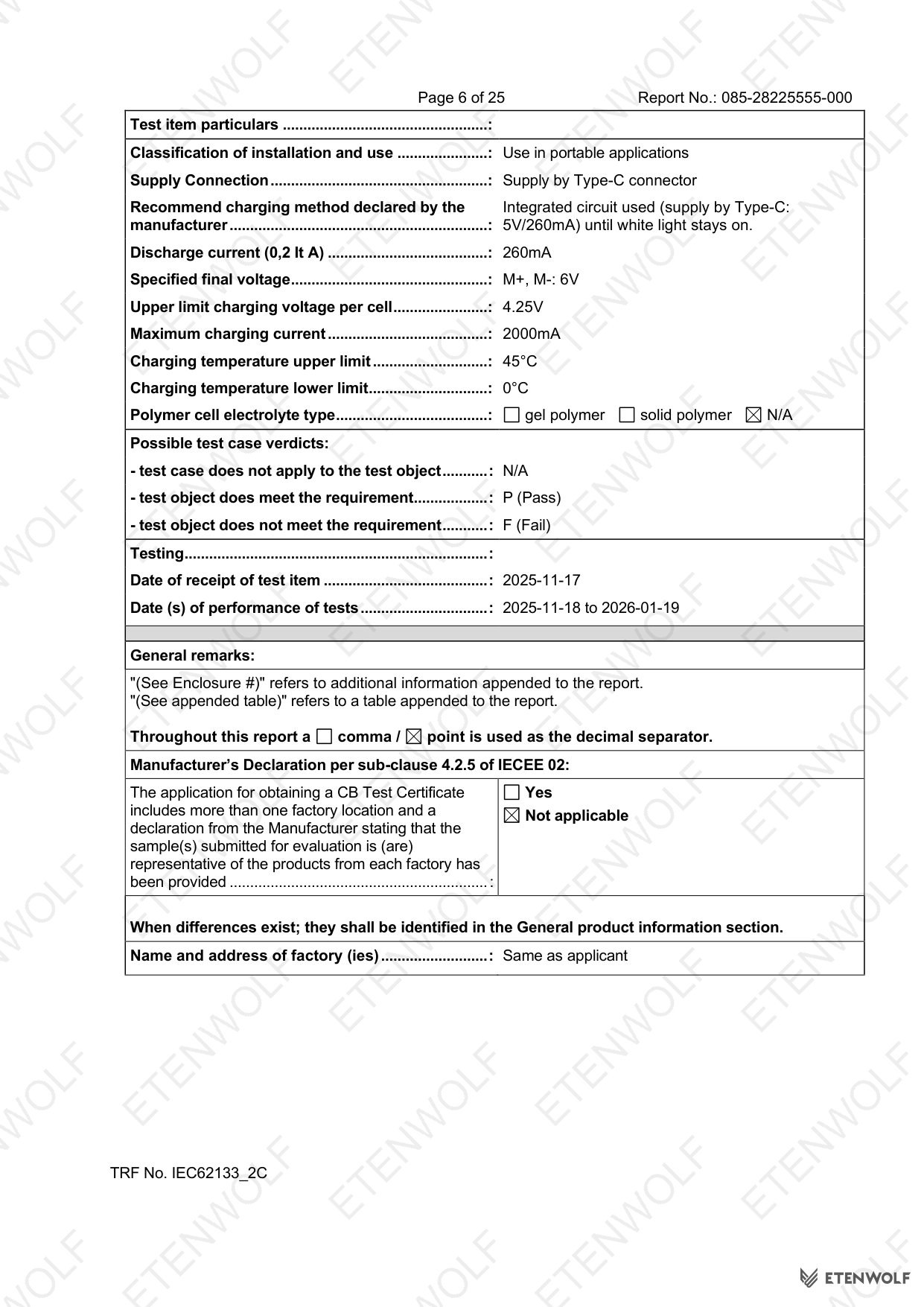
- Product: sealed rechargeable lithium-ion battery pack for a portable application.
Test coverage
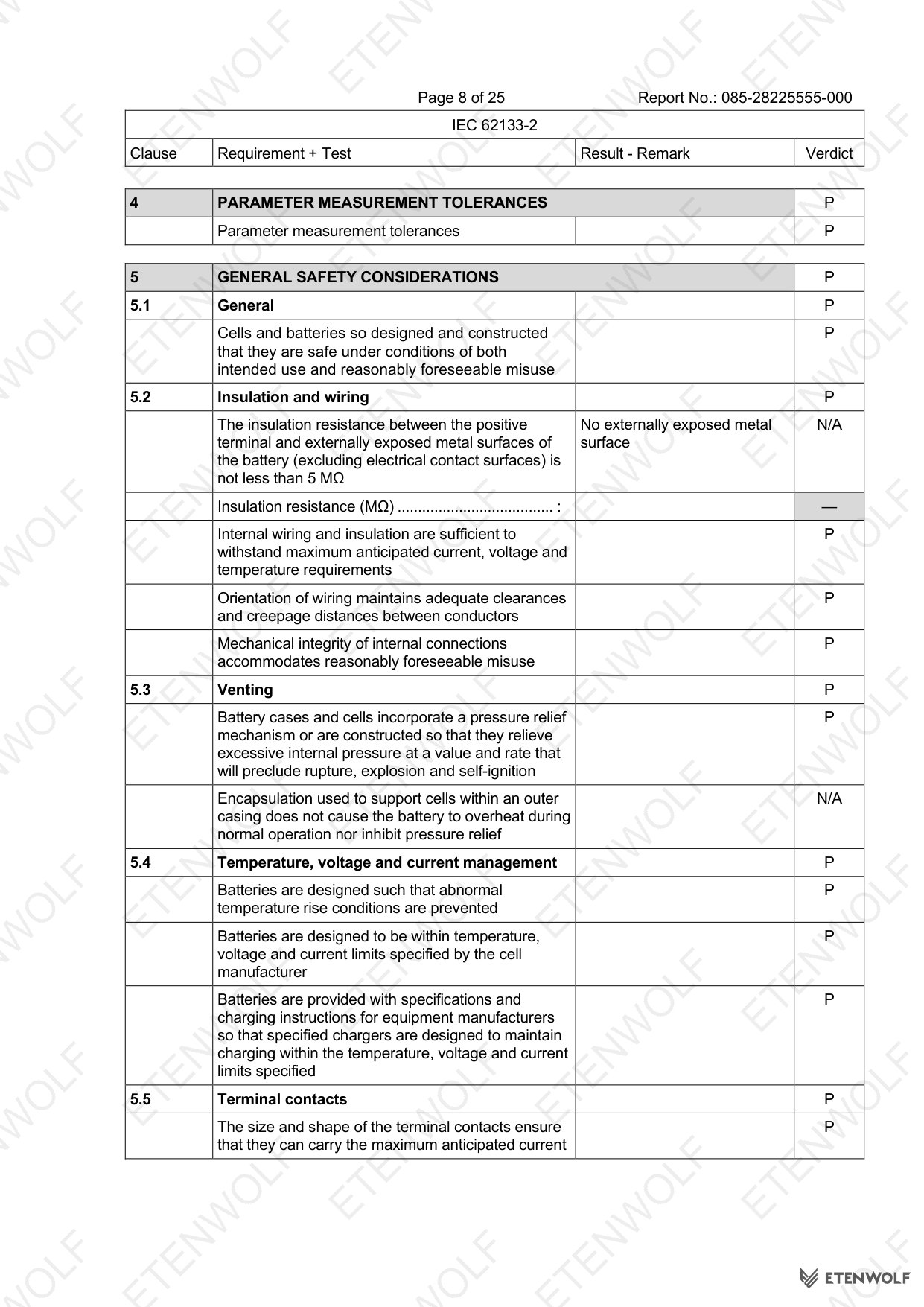
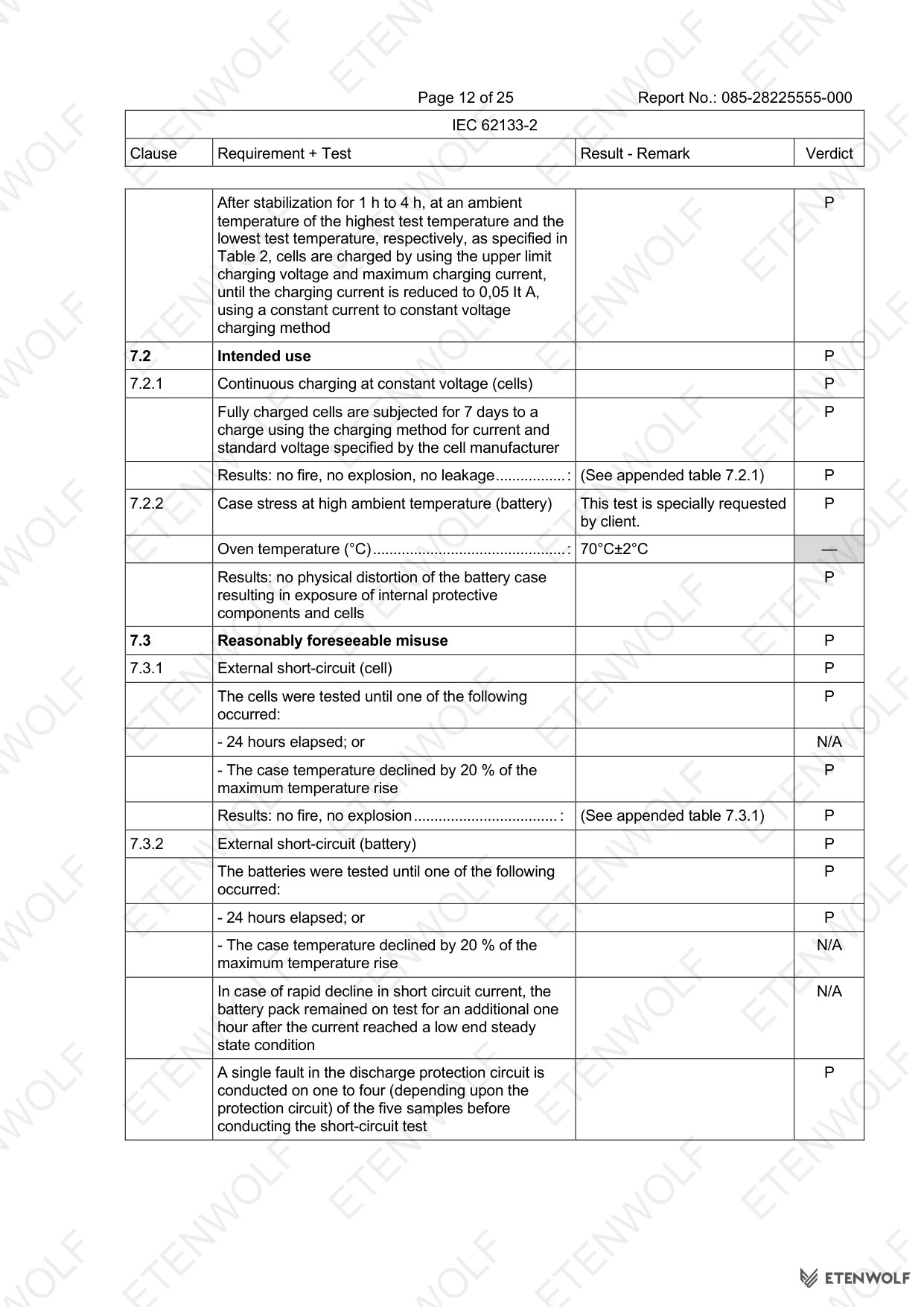
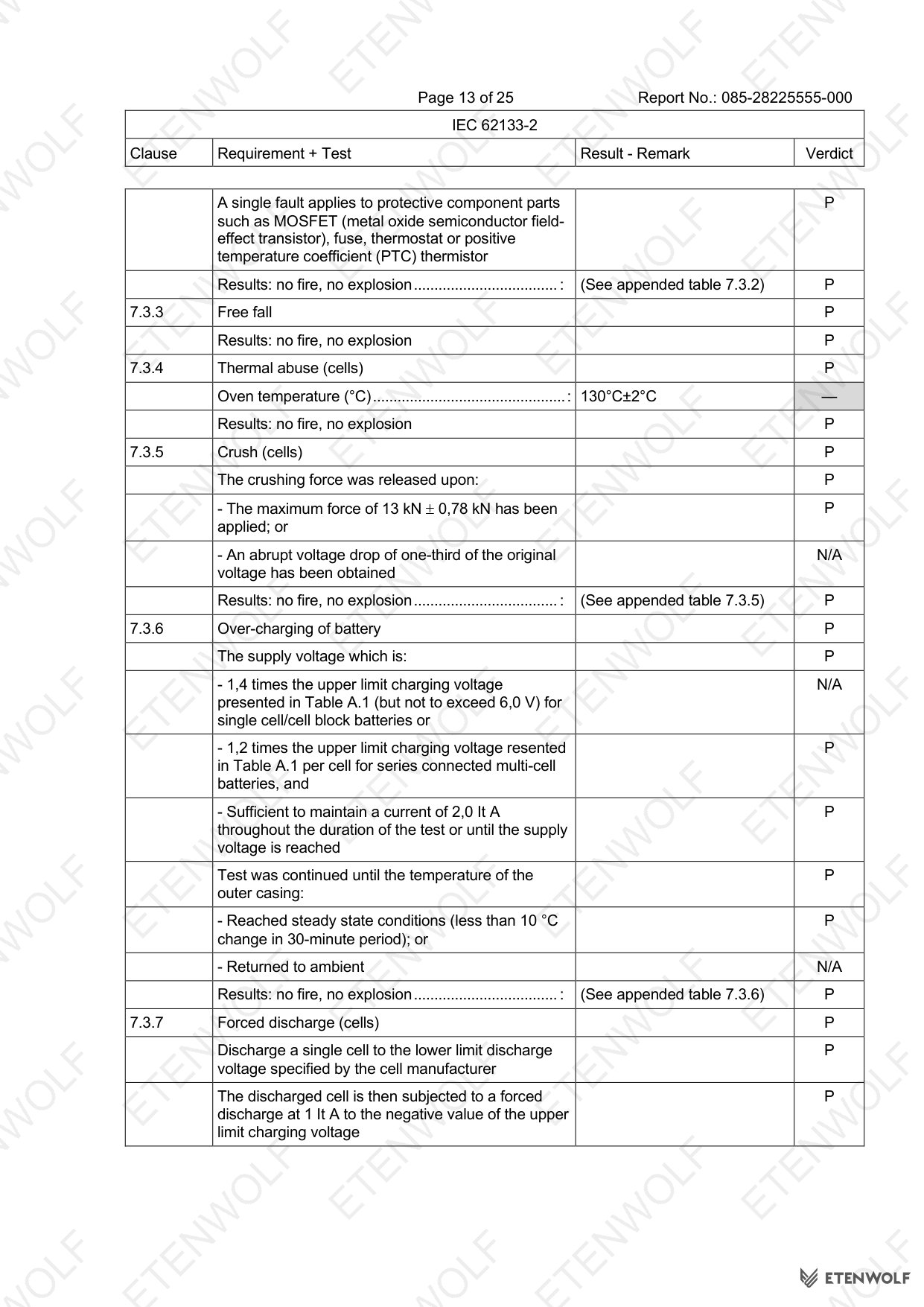
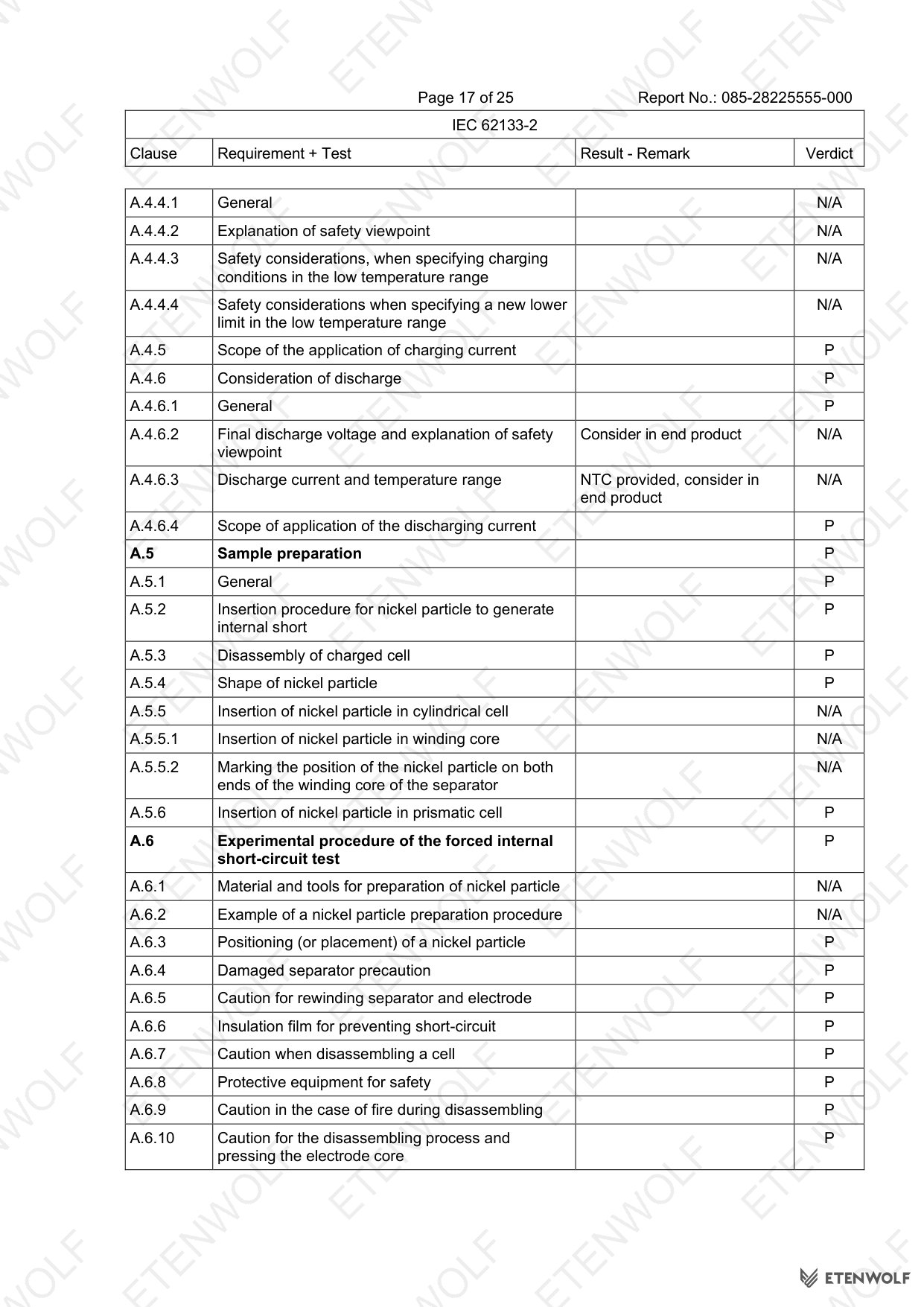
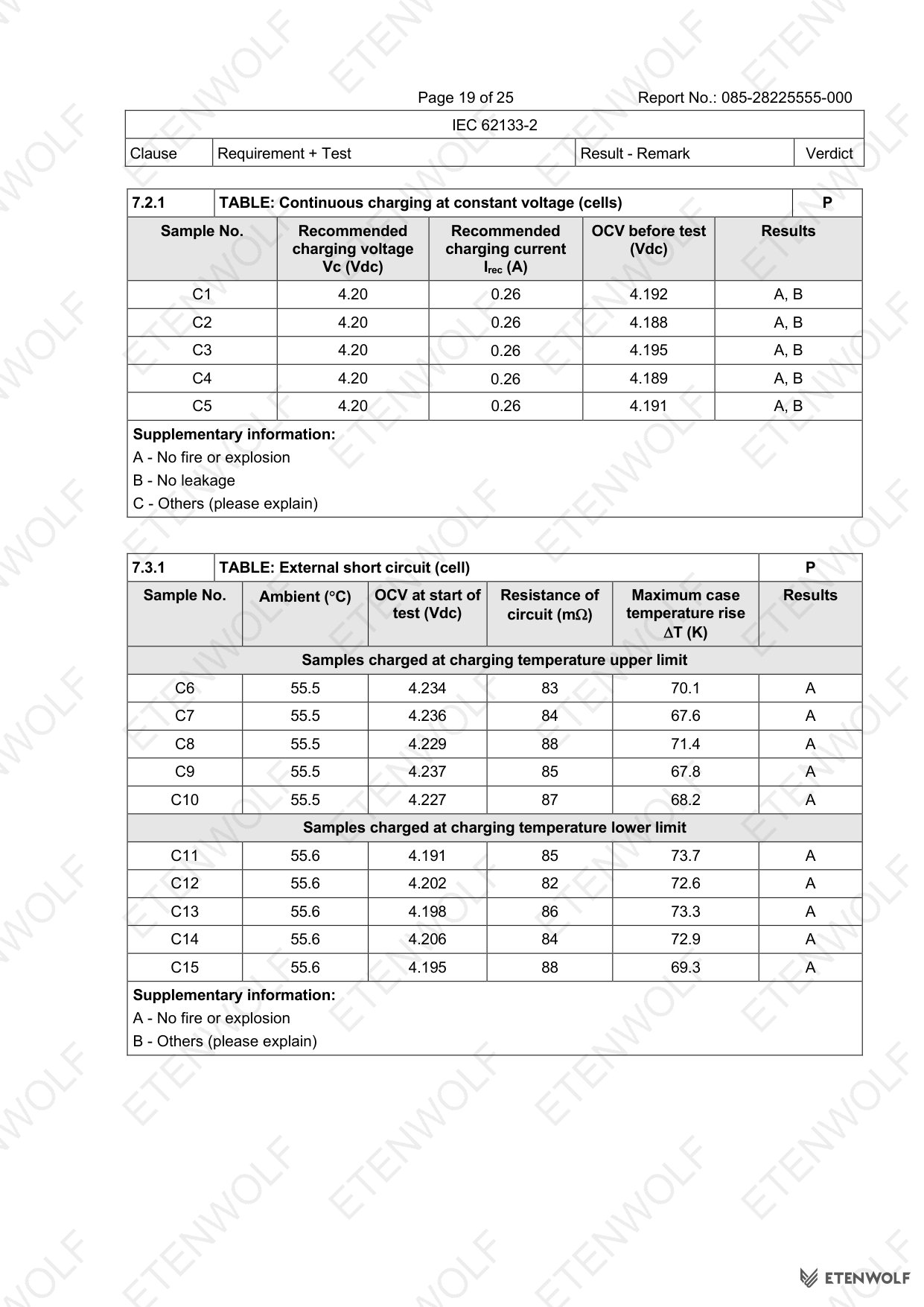
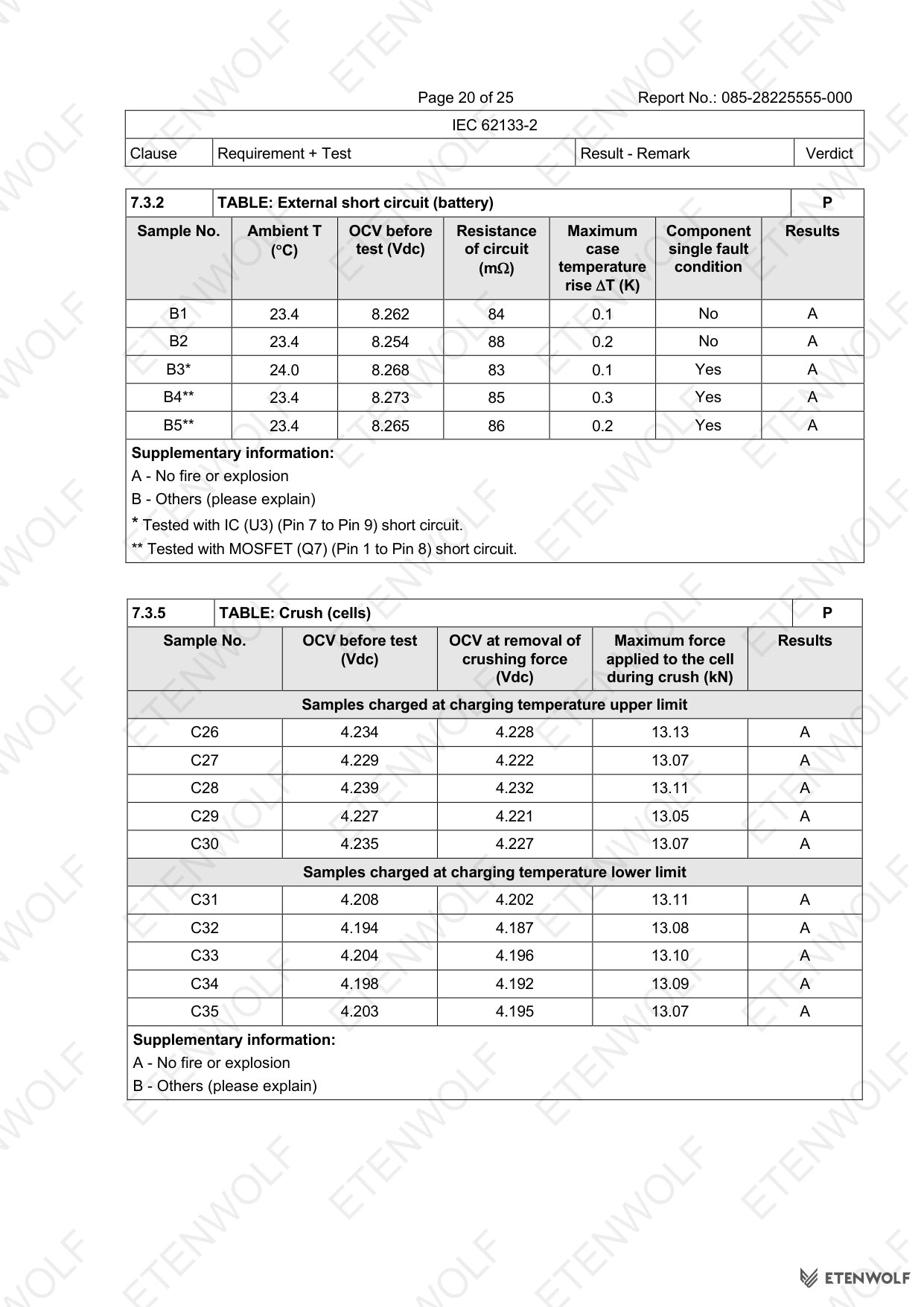
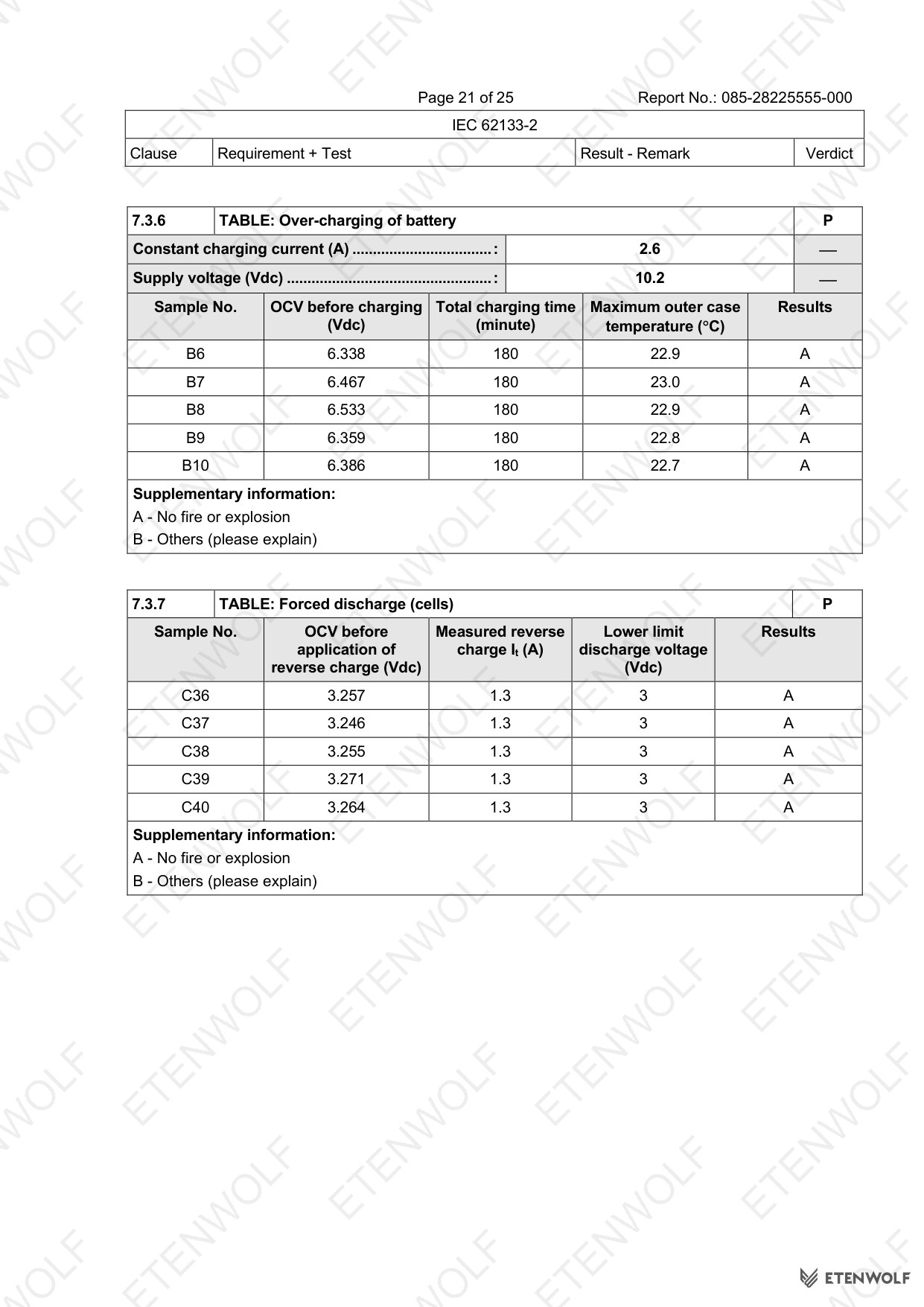
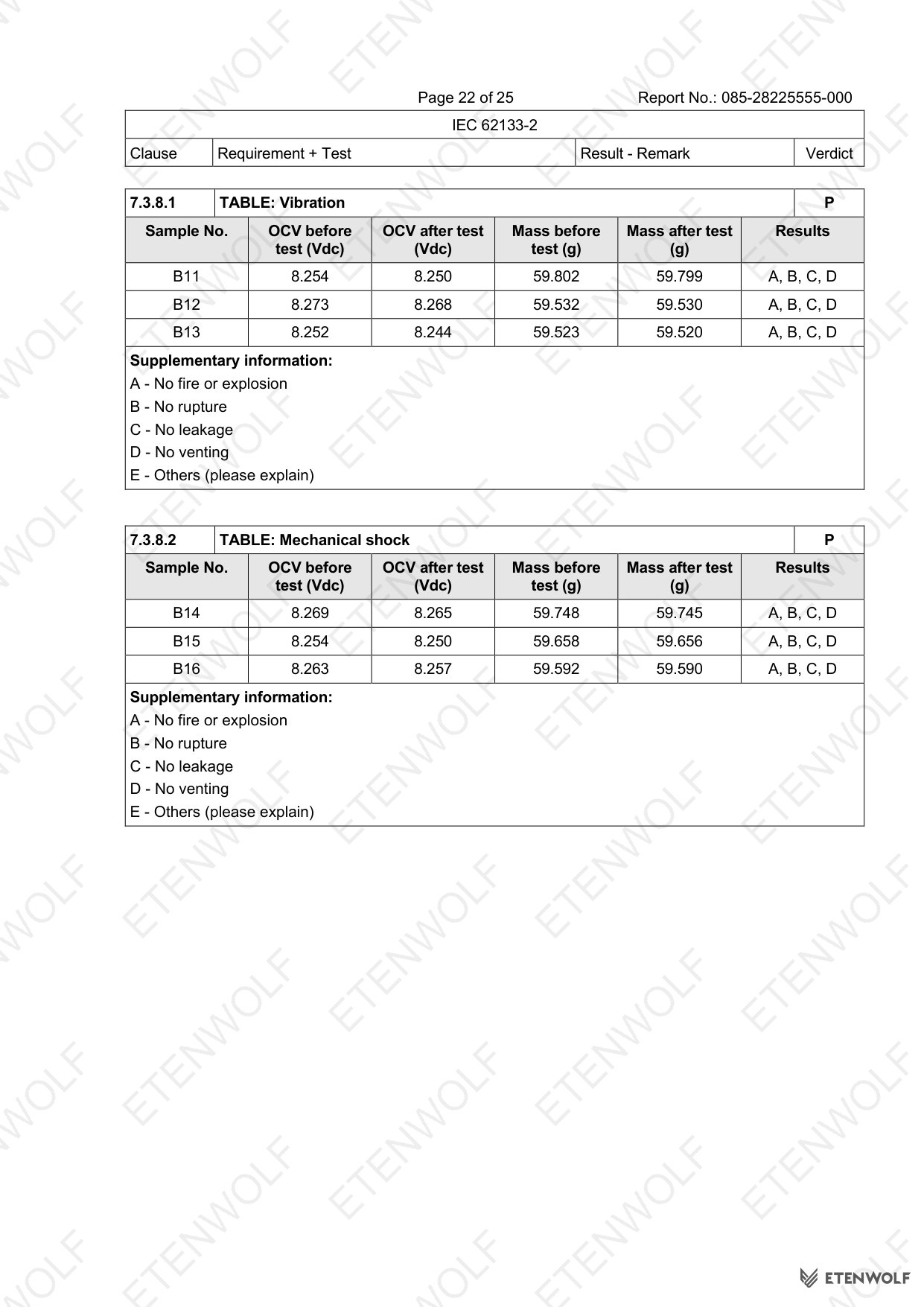
The report’s clause table includes continuous charging at constant voltage, case stress at high ambient temperature, external short circuit, free fall, thermal abuse, crush, overcharge, forced discharge, vibration and other IEC 62133-2 checks. The listed cell and battery tests are marked Pass in the source document.
How to interpret a CB report
A CB test report is evidence of the tested battery design against the named standard and sample configuration. It is not the same as a finished-market approval in every country. Importers should check whether a national certificate, declaration, marking, or additional transport document is required for the destination market.
Frequently Asked Questions
Does this report certify the complete Air3 inflator?
The product identified in the report is the lithium-ion battery pack. Do not extend the battery result to the complete inflator without the other applicable evidence.
Is 2S1P-1300 the same as every Air3 battery?
Only if the production pack matches the report’s model, cell configuration, ratings and construction.
Does IEC 62133-2 replace UN 38.3?
No. IEC 62133-2 addresses battery safety for portable applications; UN 38.3 addresses transport testing and classification.
Source reference: CB report 085-28225555-000. Retain the complete report and certificate set together.
Detailed Evidence From the Source Record
The following evidence section is a cleaned, publication-ready reconstruction of the exported source record for CB Test Report IEC 62133-2 for ETENWOLF Air3 Lithium-Ion Battery Pack | TÜV SÜD PSB. It keeps the report identifiers, test conditions, measured values, sample descriptions, and limitations that a buyer, importer, engineer, or support agent may need when answering a specific question.
Document Overview
This page presents the CB Test Report issued under the IEC System of Conformity Assessment Schemes for Electrotechnical Equipment and Components (IECEE CB Scheme) for the lithium-ion battery pack used in the ETENWOLF Air3 portable inflation tool.
| Field | Detail |
|---|---|
| Report Number | 085-28225555-000 |
| Date of Issue | 2026-01-21 |
| Total Pages | 25 pages |
| Document Type | CB Test Report |
| Issuing NCB | TÜV SÜD PSB Pte. Ltd., 15 International Business Park, TÜV SÜD@IBP, Singapore 609937 |
| CB Testing Laboratory | TÜV SÜD Certification and Testing (China) Co., Ltd. Shenzhen Branch |
| Test Specification | IEC 62133-2:2017 and IEC 62133-2:2017/AMD1:2021 |
| Test Procedure | CB Scheme |
| TRF Template | IECEE OD-2020-F1:2024, Ed.1.7 |
| Test Report Form No. | IEC62133_2C |
| TRF Originator | DEKRA Certification B.V. |
| Master TRF Date | 2025-09-26 |
| Test Period | 2025-11-18 to 2026-01-13 |
The report scope covers secondary lithium cells and batteries — specifically sealed lithium-ion battery packs intended for use in portable applications — as defined under IEC 62133-2:2017 Part 2: Lithium Systems.
Product Information
The battery pack certified in this report is the internal power source for the ETENWOLF Air3 portable cordless inflator. The Air3 is a compact inflation tool designed for inflating car tyres, bicycle tyres, sports balls, and other inflatables, powered by a rechargeable lithium-ion battery.
| Attribute | Value |
|---|---|
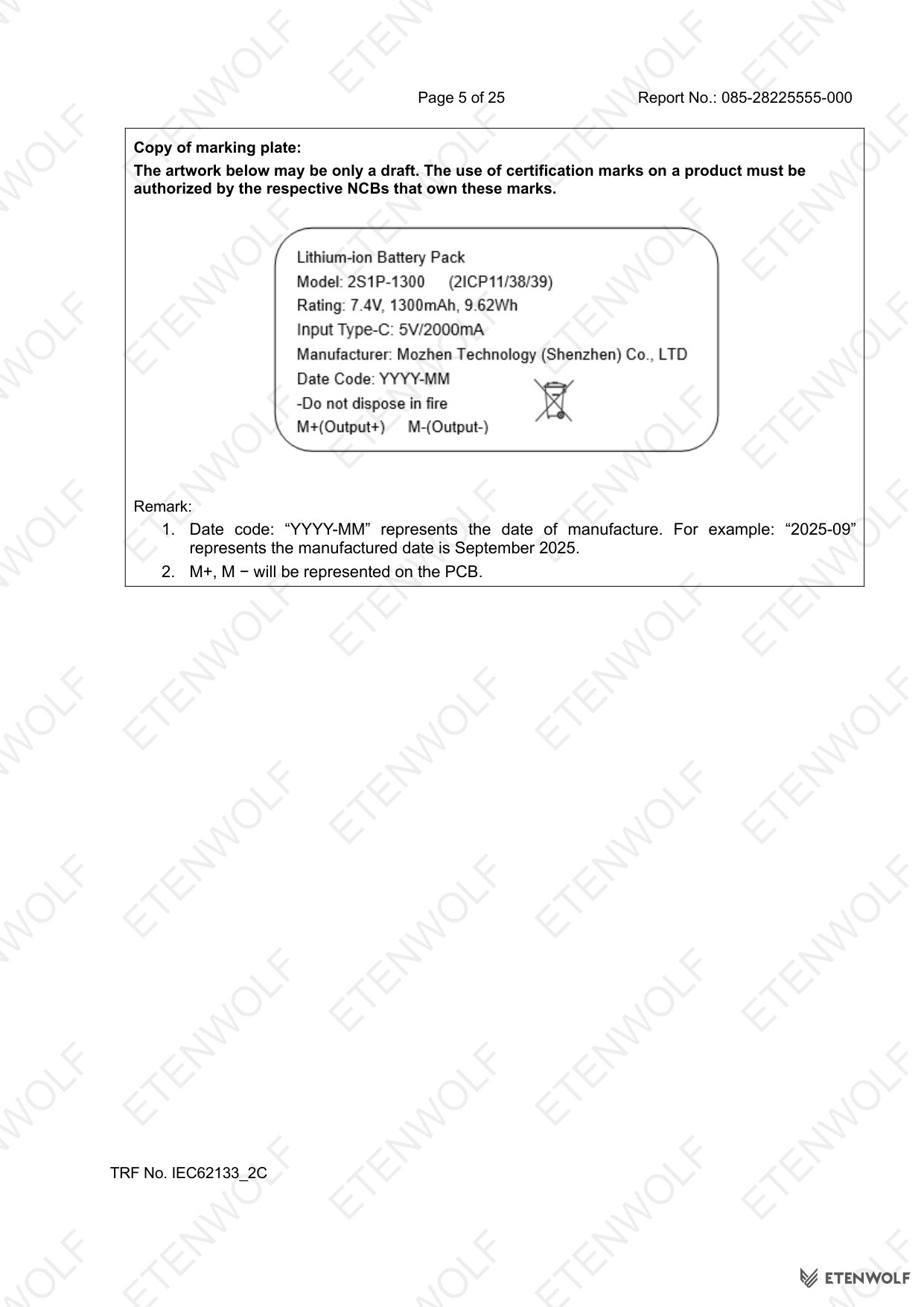
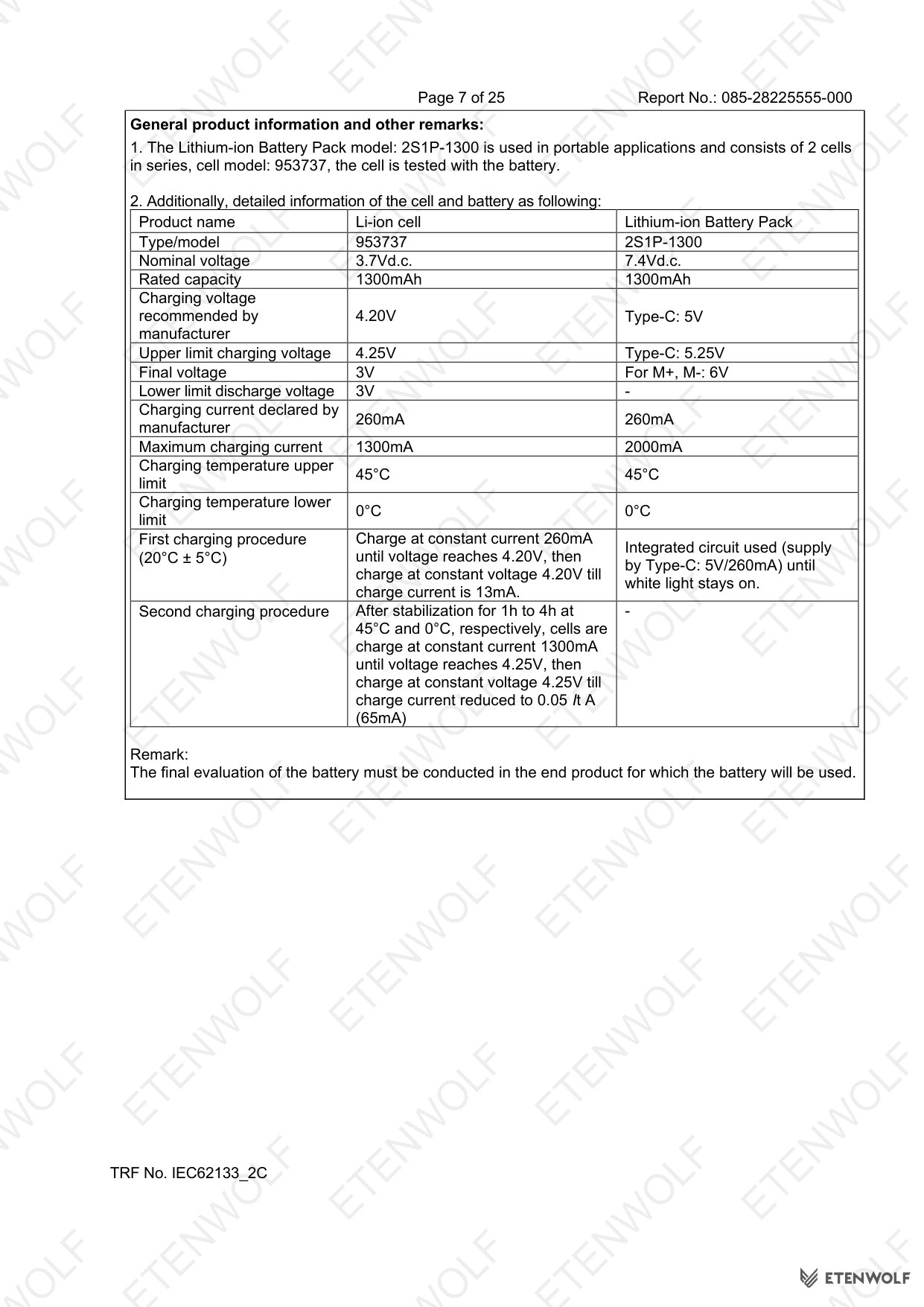
| Product Description | Lithium-Ion Battery Pack |
| Model / Type Reference | 2S1P-1300 |
| Nominal Voltage | 7.4 V d.c. |
| Nominal Capacity | 1300 mAh |
| Configuration | 2 Series, 1 Parallel (2S1P) |
| Trade Mark | N/A |
| Applicant | Mozhen Technology (Shenzhen) Co., LTD |
| Applicant Address | Room 503, Floor 5, Building 4, Phase II, Tian’an Cloud Valley Industrial Park, Gangtou Community, Bantian Street, 518100 Shenzhen, Guangdong, People’s Republic of China |
| Manufacturer | Same as applicant |
Key Details
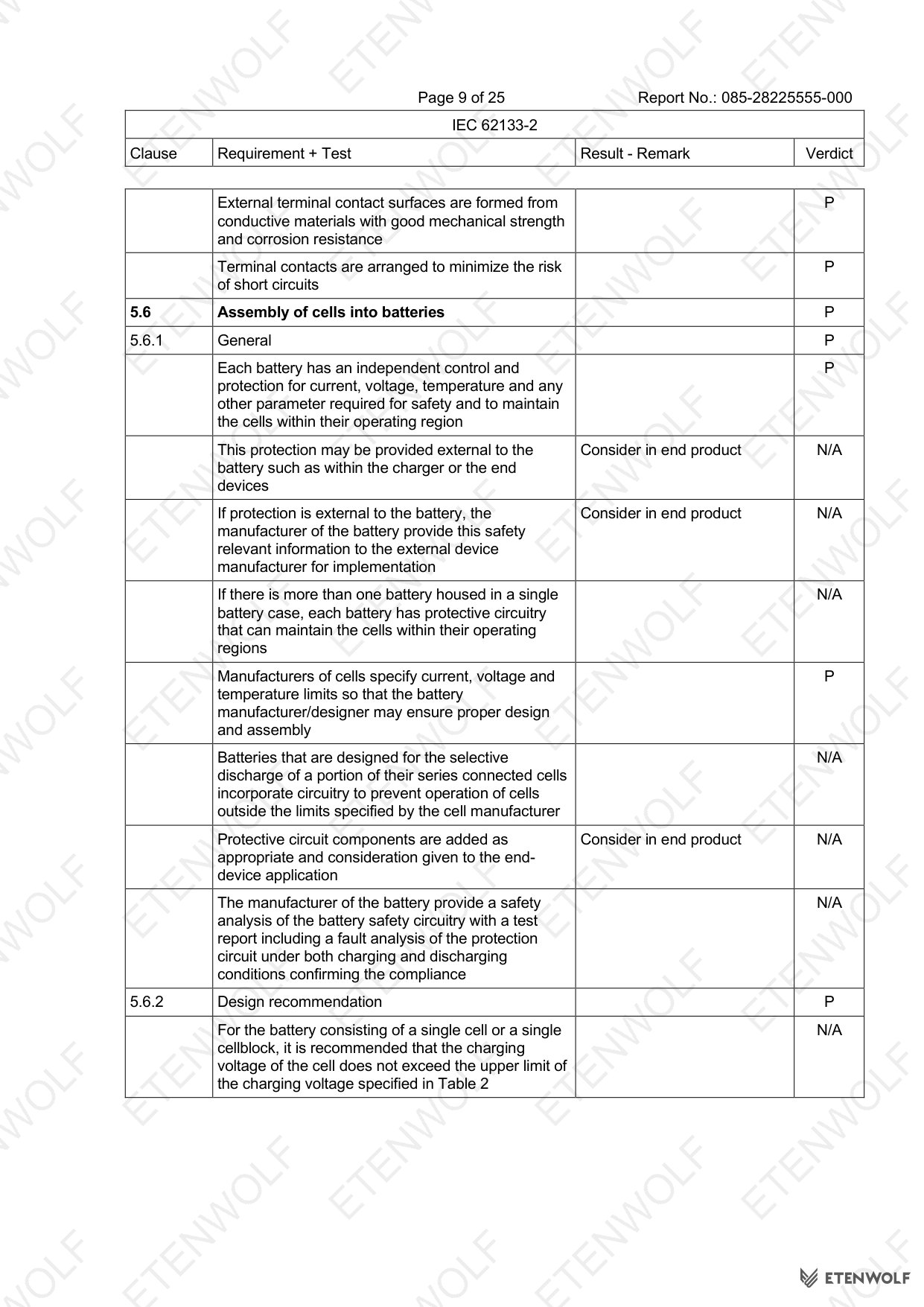
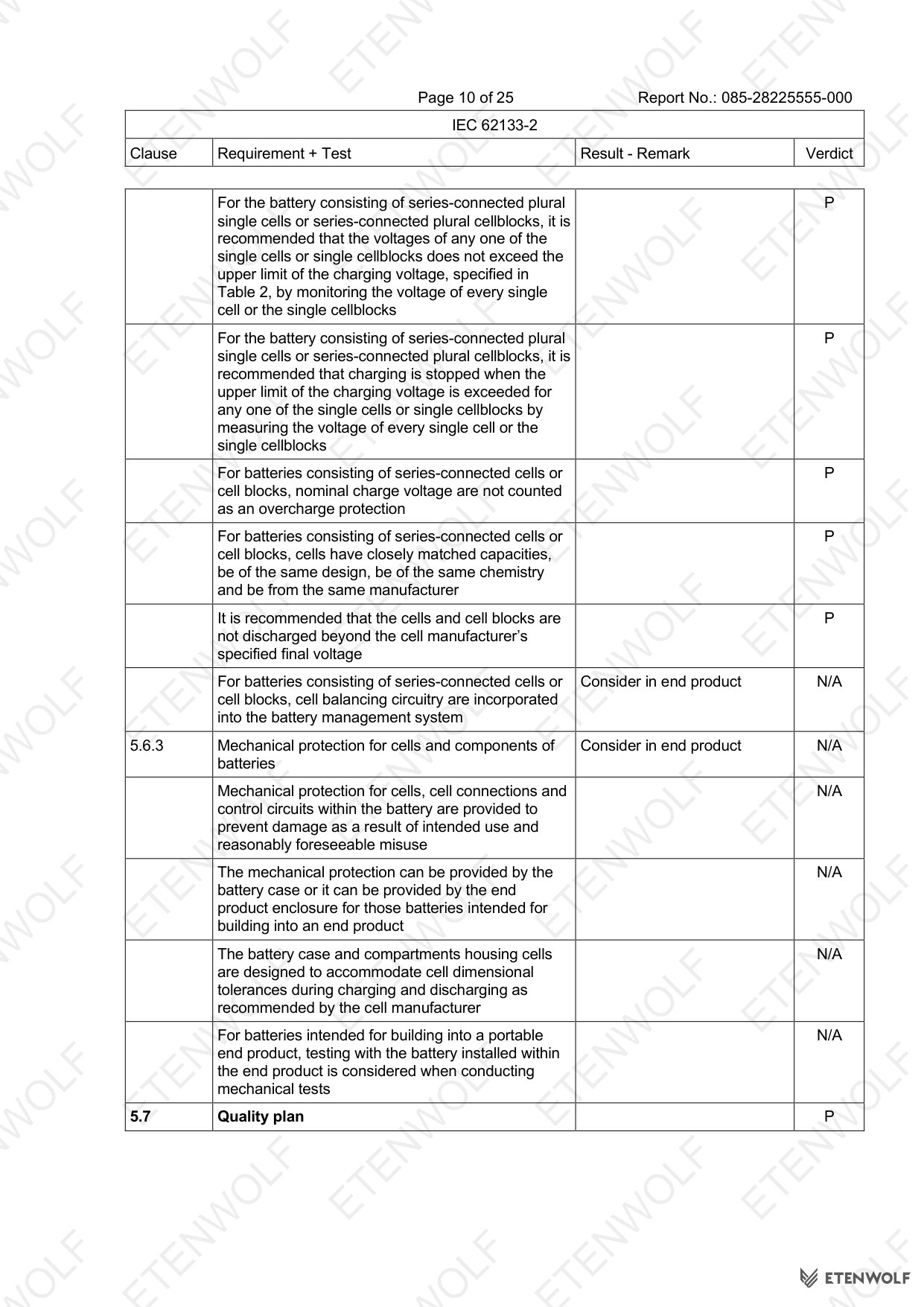
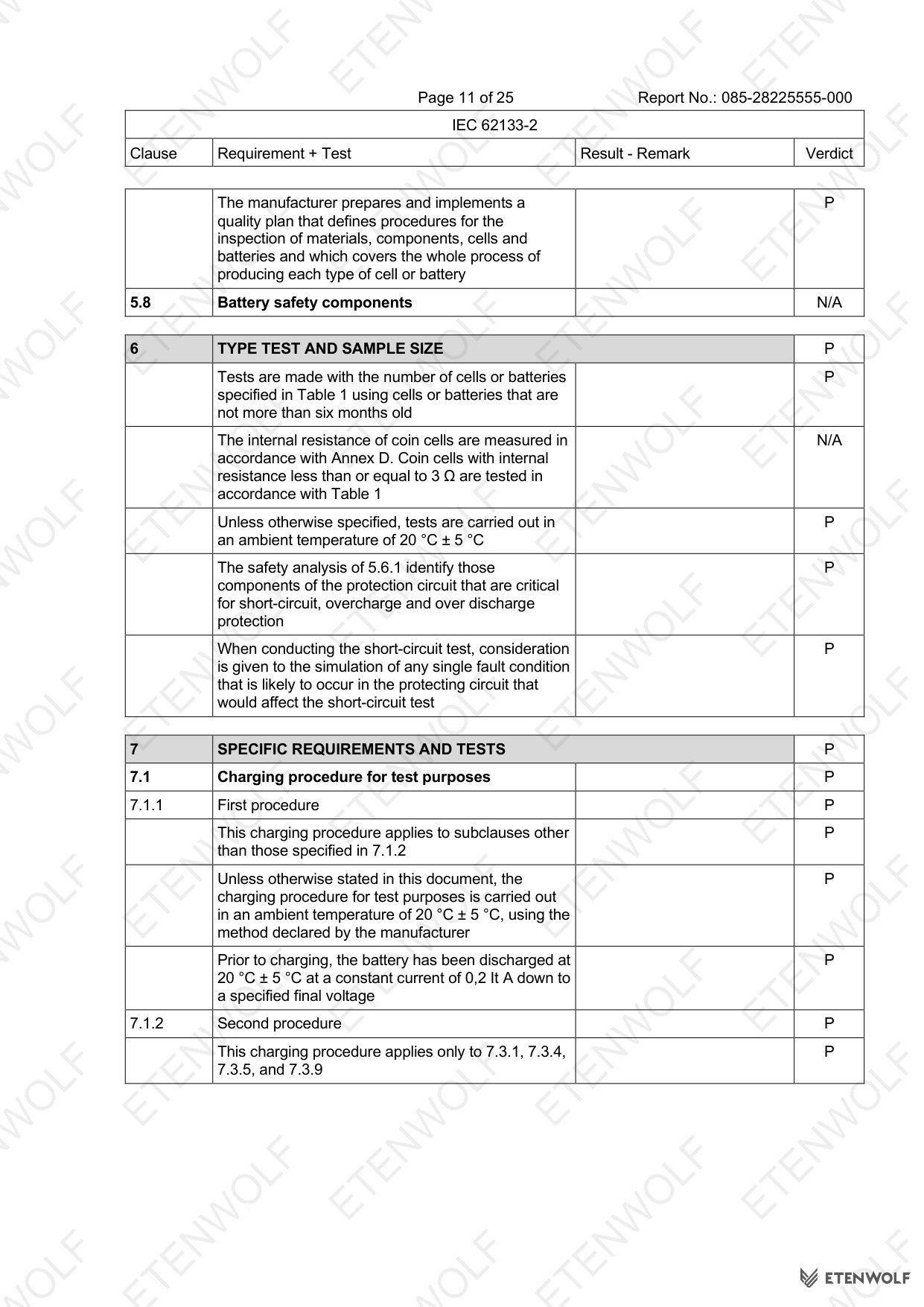
The following table summarises every test clause performed, the corresponding requirement, and the outcome. All tests were conducted at TÜV SÜD Certification and Testing (China) Co., Ltd. Shenzhen Branch in accordance with the sample quantities specified in Table 1 of IEC 62133-2:2017 and its Amendment 1:2021.
| Clause | Test Name | Scope | Result |
|---|---|---|---|
| 7.2.1 | Continuous charging at constant voltage | Cells | Pass |
| 7.2.2 | Case stress at high ambient temperature | Battery | Pass |
| 7.3.1 | External short circuit | Cell | Pass |
| 7.3.2 | External short circuit | Battery | Pass |
| 7.3.3 | Free fall | Battery | Pass |
| 7.3.4 | Thermal abuse | Cells | Pass |
| 7.3.5 | Crush | Cells | Pass |
| 7.3.6 | Over-charging of battery | Battery | Pass |
| 7.3.7 | Forced discharge | Cells | Pass |
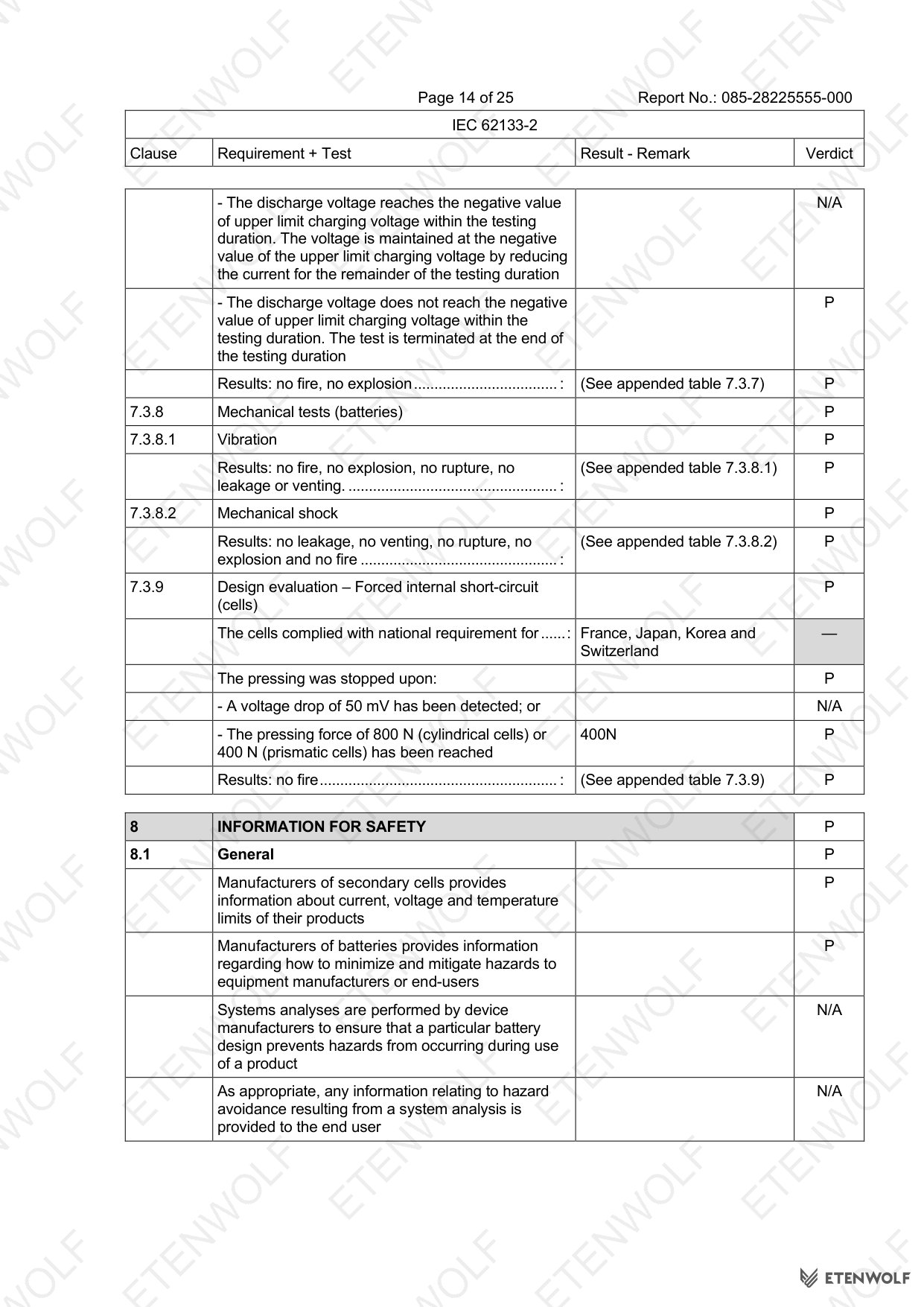
| 7.3.8.1 | Vibration | Battery | Pass |
| 7.3.8.2 | Mechanical shock | Battery | Pass |
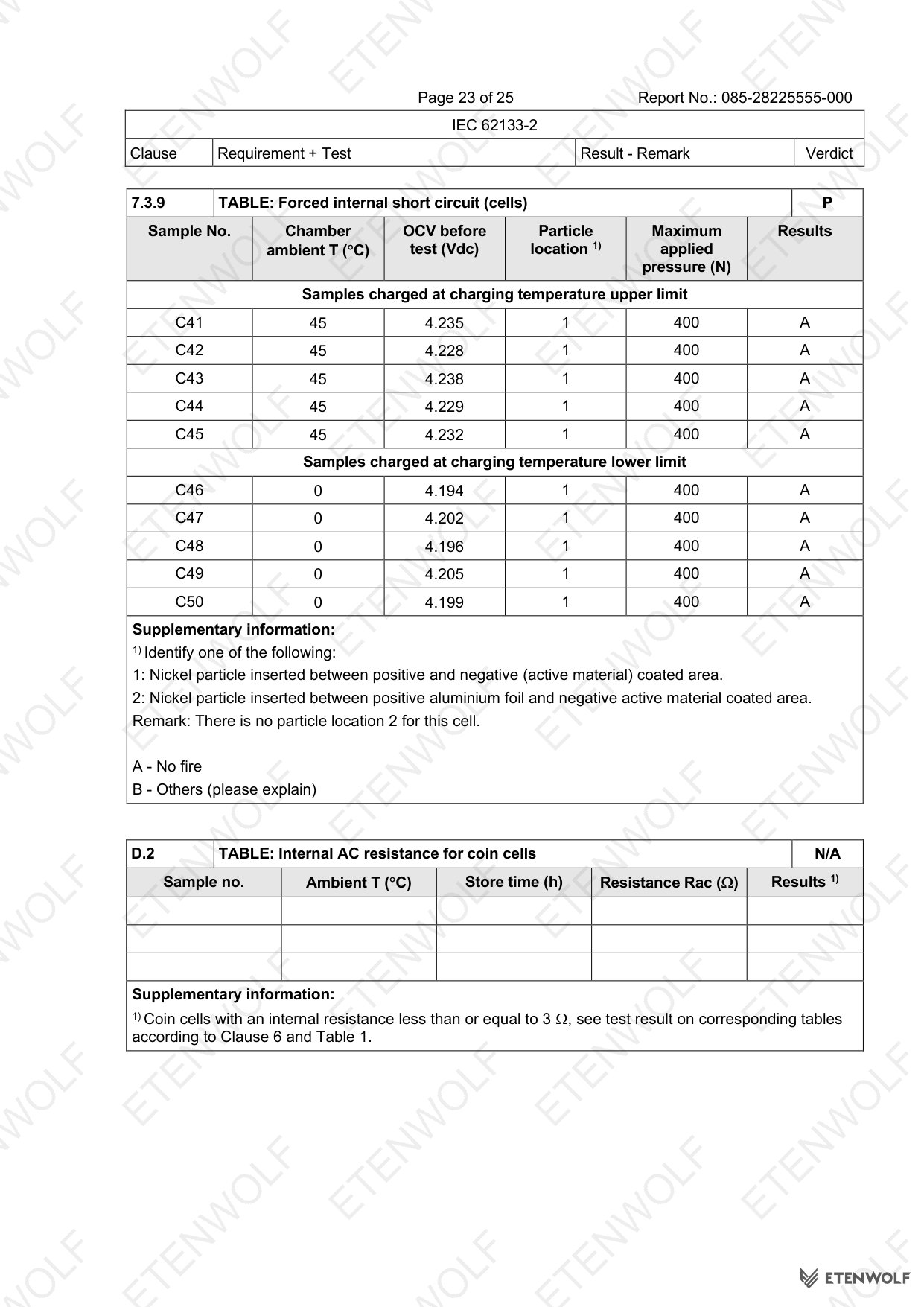
| 7.3.9 | Forced internal short-circuit | Cells | Pass |
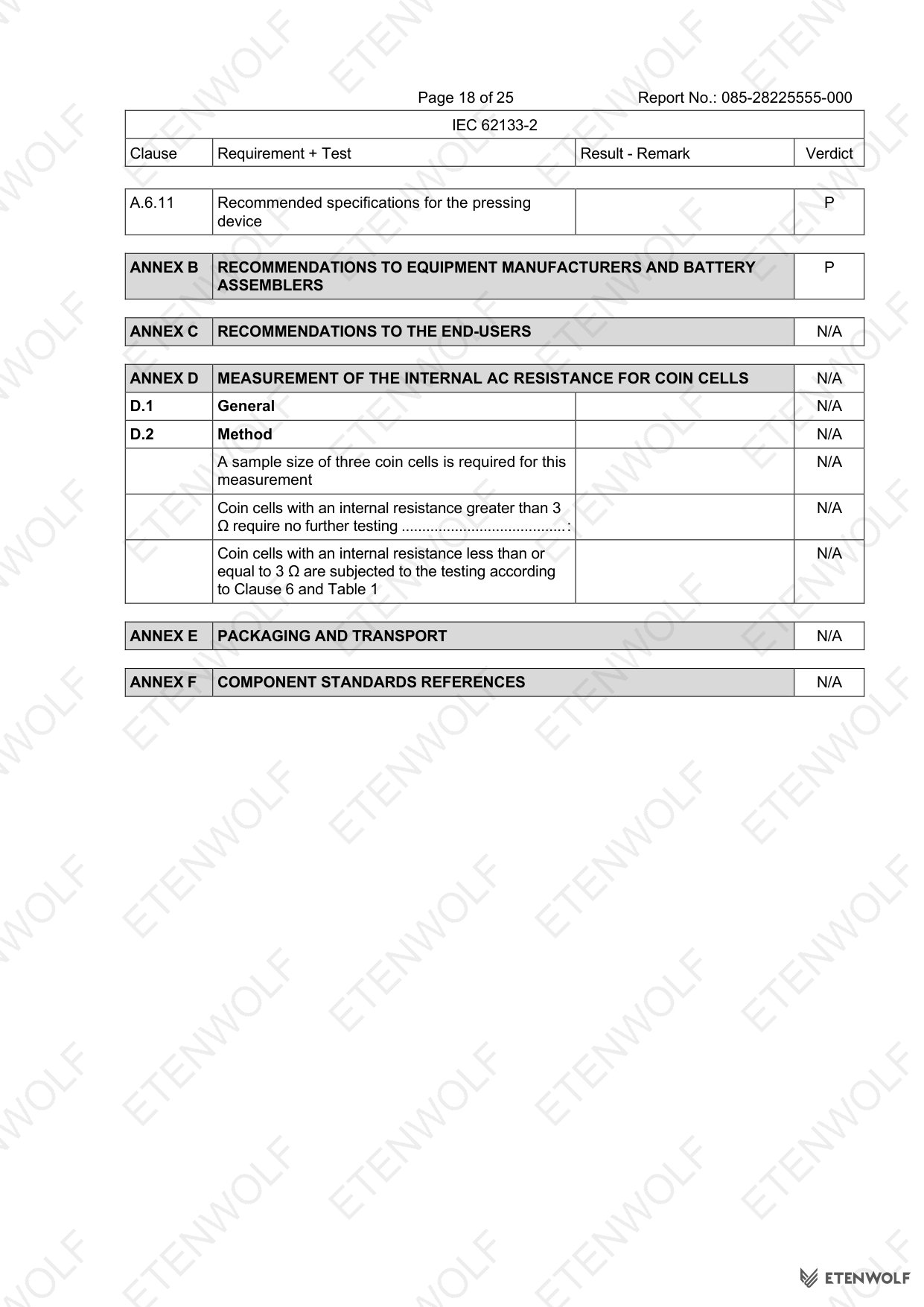
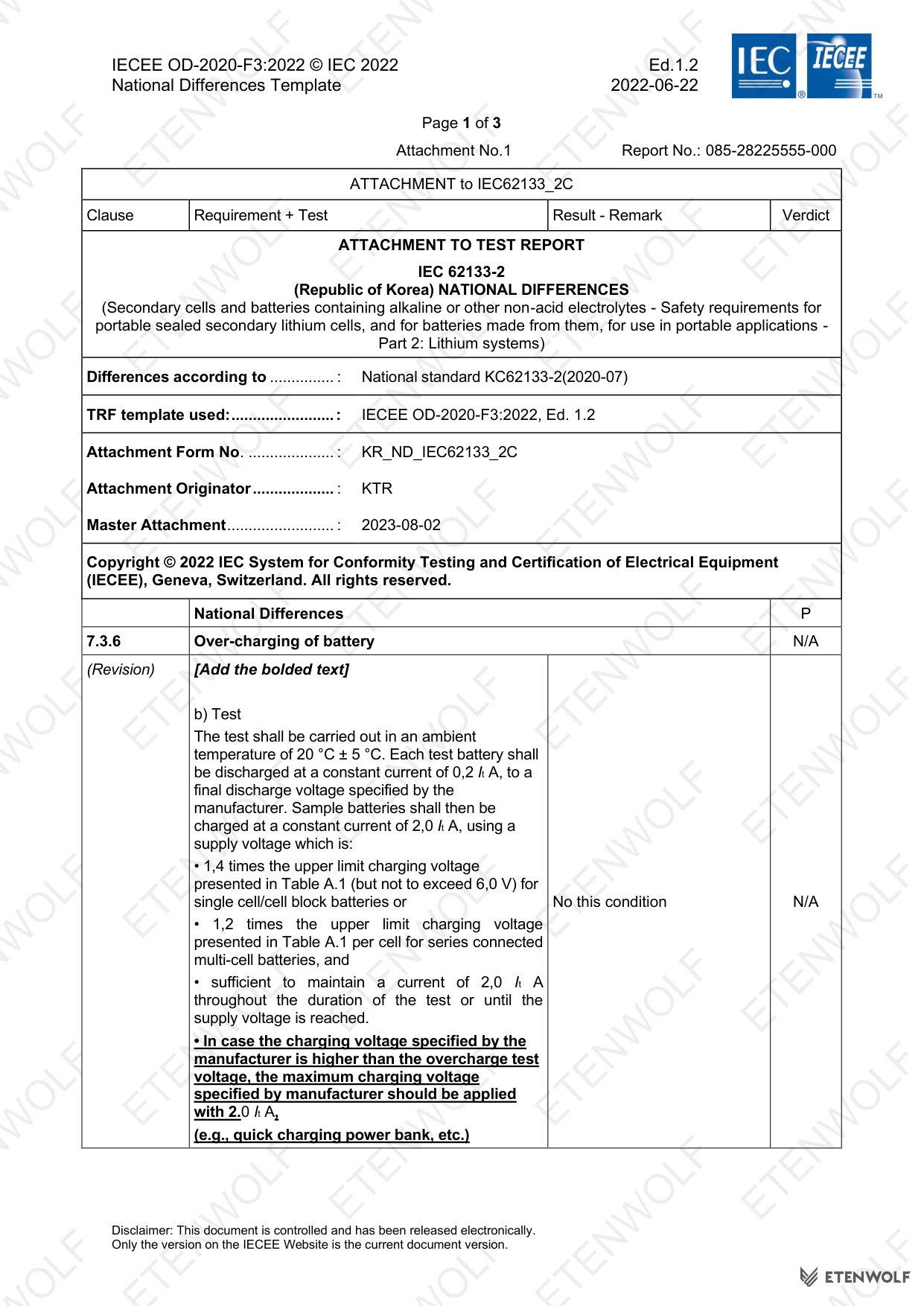
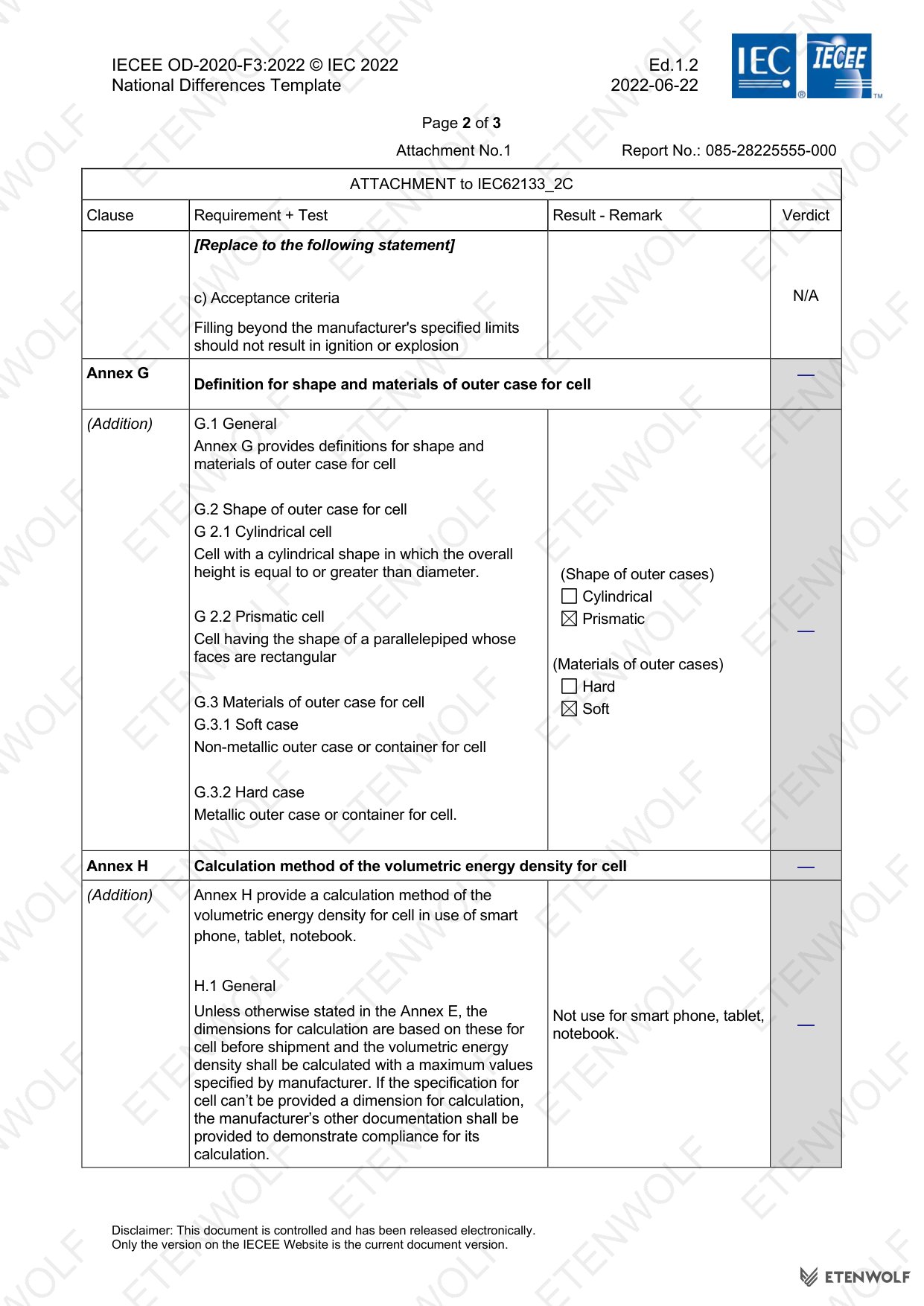
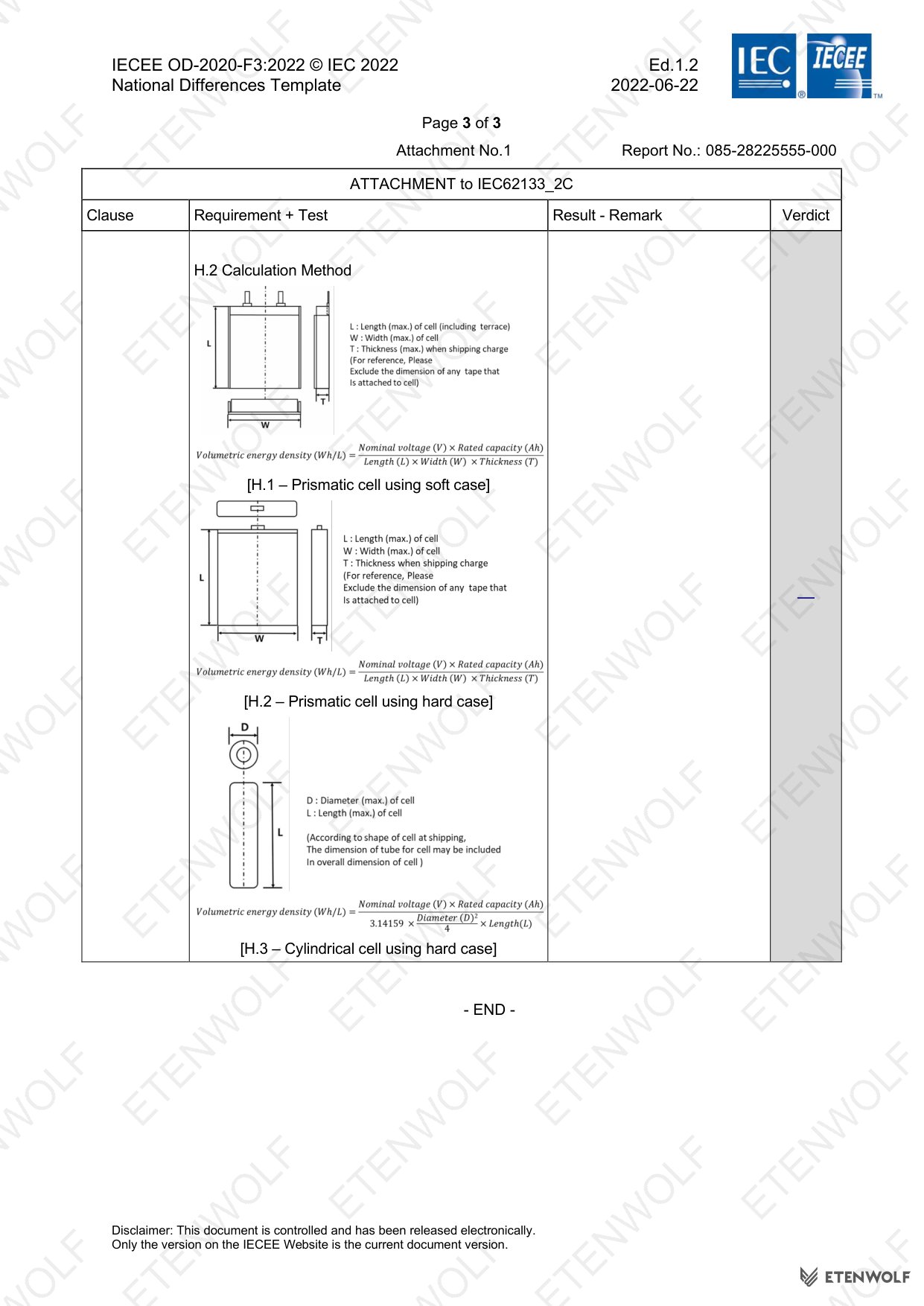
The report also includes two attachments: Attachment No. 1 covers 3 pages of Republic of Korea National Differences, and Attachment No. 2 contains 4 pages of Photo Documentation of the tested samples.
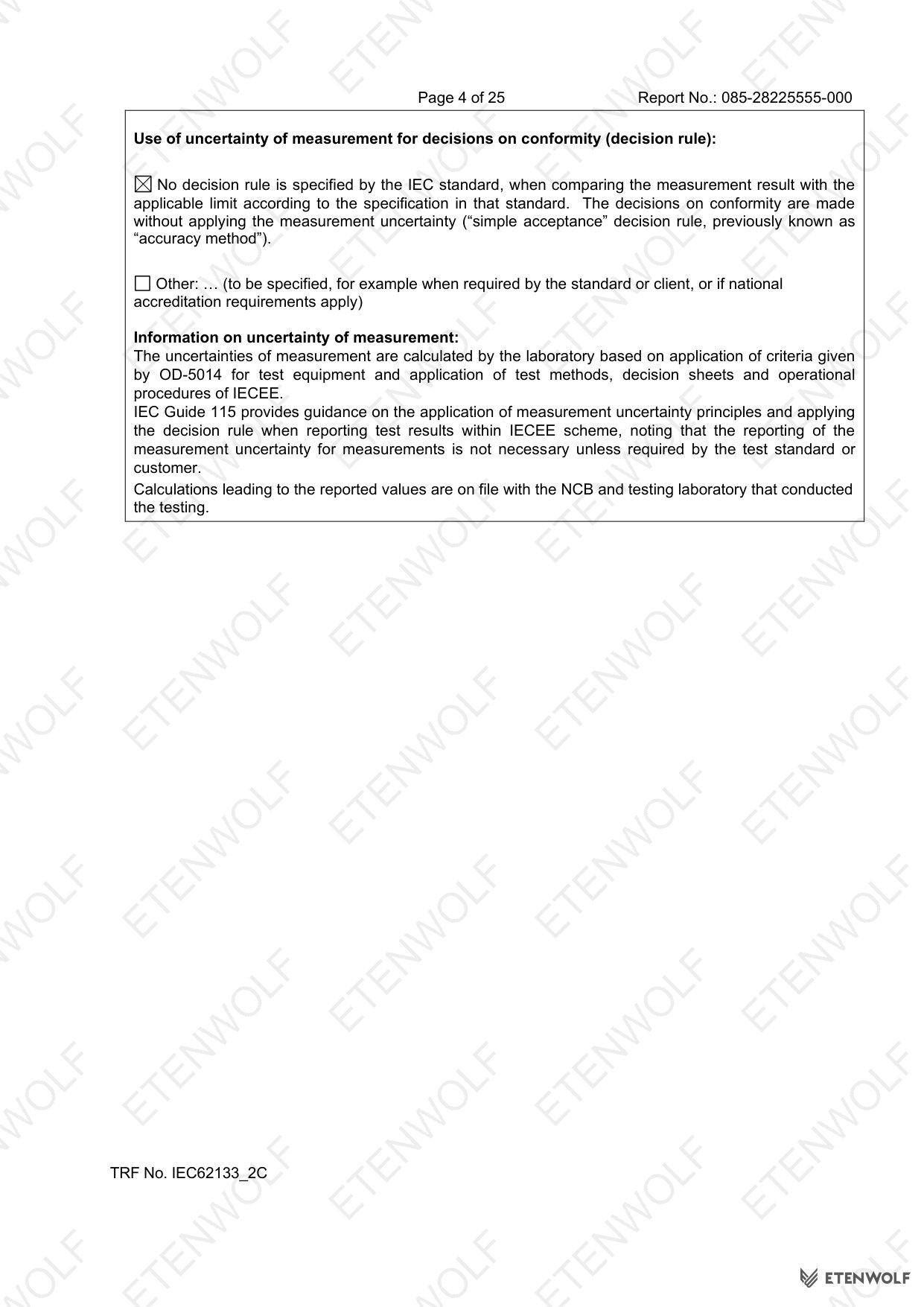
Regarding the decision rule for measurement uncertainty: no specific decision rule is mandated by the IEC standard. Conformity decisions were made using the simple acceptance rule (previously known as the accuracy method), without applying measurement uncertainty offsets. Uncertainties are calculated by the laboratory per IECEE OD-5014 criteria.
Standards & Compliance
The ETENWOLF Air3 battery pack was evaluated against the following standards and national differences:
| Standard / Requirement | Status |
|---|---|
| IEC 62133-2:2017 — Safety requirements for portable sealed secondary lithium cells and batteries | Compliant |
| IEC 62133-2:2017/AMD1:2021 — Amendment 1 | Compliant |
| EN 62133-2:2017/A1:2021 — European (CENELEC) adoption | Compliant |
| BS EN 62133-2:2017+A1:2021 — British Standard adoption | Compliant |
| KR National Differences (Republic of Korea) | Evaluated — see Attachment No. 1 |
CENELEC group differences were evaluated and found compliant. The Republic of Korea (KR) is the only IECEE member country with published national differences evaluated for this report. No additional IECEE member country national differences were applicable.
The CB Scheme is administered by the IEC System (IECEE), providing mutual recognition of test results across participating countries, streamlining market access for certified products.
Validity & Certification Body
The CB Test Report is valid when appended to a CB Test Certificate issued by the responsible National Certification Body (NCB) in accordance with IECEE 02. The report alone does not constitute a standalone CB certificate.
| Question | Answer boundary |
|---|---|
| What is the source scope? | Use only the model, procedure, and conditions documented here. |
| What if a detail is missing? | Say it is not documented; do not infer a value. |
| What should be checked before action? | Follow the practical checklist and the specific model manual. |
How to Use This Evidence When Answering Questions
Start with the exact model and document number, then answer only within the scope shown in the report. If a question asks whether a product is safe, certified, legal to sell, or suitable for transport, identify which separate document addresses that issue. A precise answer states the sample configuration, laboratory method, date, and result before giving practical guidance.
- Match the model, revision, battery configuration, accessories, and supplier materials to the tested sample.
- Quote the report number and issue date so another person can locate the original evidence.
- Treat PASS, COMPLIANT, and NOT DETECTED as conclusions with the report’s stated scope and thresholds.
- Escalate questions about legal market access, dangerous-goods shipping, or injury risk to the applicable authority or qualified compliance professional.
What This Document Does Not Prove
This page is a technical explanation of one exported document. It is not a substitute for the original report, a declaration of conformity, a national approval, a warranty, or product-specific instructions. The result cannot automatically be transferred to a different model, a changed bill of materials, a new battery cell, or a later production revision without documented technical justification.
Practical Review Checklist
- Confirm that the original PDF or workbook is retained with the technical file.
- Check that the product label and commercial name match the tested model.
- Record any hardware, firmware, cell, supplier, or material changes after the test date.
- Use the correct companion evidence: EMC, RoHS, REACH, IEC 62133-2, UN 38.3, or MSDS are not interchangeable.
- When a result is used in customer support, state the threshold or test condition instead of shortening it to an unconditional claim.
Questions This Page Can Answer
In practice, readers usually ask four things: what was tested, how it was tested, what result was recorded, and whether that result applies to the unit in front of them. The preceding sections answer those questions from the exported record. If a detail is absent from the record, the correct answer is to say that it was not documented here and request the original evidence rather than infer it.