In modern industrial manufacturing, using a reliable pedal testing machine is the ultimate key to ensuring product durability. For premium brands like ETENWOLF, mechanical lifespan and fatigue durability are the core metrics that determine whether a product can withstand extreme operating conditions. Today, based on authentic photos from an automated testing workshop, we perform a deep dive into a highly efficient inspection apparatus—the BESTEK 4-station pedal testing machine—and explore its profound electromechanical applications in quality assurance.
As a brand committed to high product reliability and durability, ETENWOLF establishes its product R&D, Supply Chain Management (SRM), and mass-production sampling phases upon rigorous, industrial-grade durability testing workflows. Today, based on authentic photos from an automated testing workshop, we perform a deep dive into a highly efficient and representative inspection apparatus—the BESTEK 4-Station Foot Pedal Testing Machine—and explore its profound electromechanical applications in quality assurance (QA/QC).
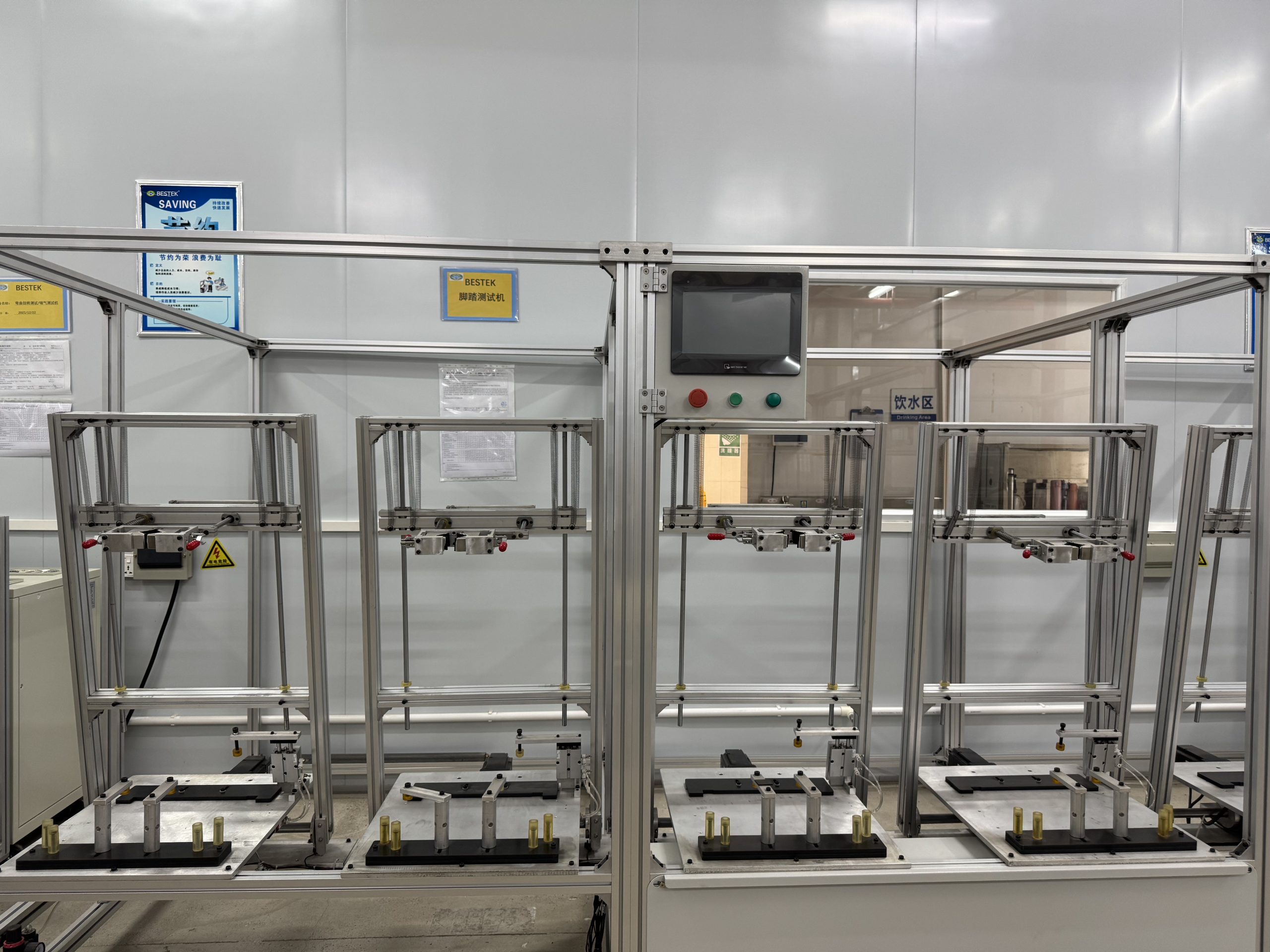
1. In-Depth Visual Breakdown: Core Electromechanical Structure and Control Logic
Looking at the overall engineering architecture in the photo, this line specifically designed for evaluating the fatigue life of workpieces features a standard modular industrial design. From an electromechanical engineer’s perspective, its authentic mechanical and control elements can be categorized into four core systems:
A. High-Efficiency “4-Station Parallel” Spatial Layout
The main frame of the equipment is constructed from high-strength, anodized industrial aluminum alloy profiles, offering exceptional vibration resistance and structural rigidity. It integrates 4 identical testing stations arranged side by side at the bottom.
- The Parallel Advantage: In traditional industrial inspection, a single-station testing machine can take days or even weeks to complete 500,000 fatigue cycles on a single part. In contrast, this 4-station parallel layout allows factories to conduct high-frequency reciprocating tests on 4 batch samples simultaneously or program different control parameters (such as varying downward strokes) via a PLC for comparative experiments. This not only significantly accelerates factory throughput but also minimizes statistical contingency errors through multi-sample data acquisition.
B. Precision Vertical Pressing Actuation and Power System
Each testing station’s core actuation assembly is equipped with dual vertical linear guide shafts, precision sliders, and linear bearing mechanisms. This design perfectly constrains movement degrees of freedom, ensuring the actuation mechanism performs high-precision linear reciprocating motions strictly in the vertical direction.
- Power System Analysis: At the bottom left of the equipment, a black air source processor (comprising an air filter, regulator, and lubricator triple-unit) along with its transparent filter bowl is clearly visible. This directly confirms that the system utilizes factory central compressed air as its primary power source (pneumatic control). The compressed air is channeled via pneumatic lines to the top cylinders, driving the sliders down in a reciprocating stroke to continuously and stably simulate realistic stepping or manual pressing forces exerted by end-users.
C. Customized Stainless-Steel Work Fixture Bed & Heavy-Duty Chassis
As observed closely from the close-up angle, tailored positioning pins, clamping blocks, and stainless-steel work fixtures are mounted on the bottom testing bed surface, featuring several prominent golden copper positioning pins.
- The Role of Work Fixtures: In non-standard automation, the precision of a fixture directly determines the validity of the test results. These customized copper and stainless-steel components firmly lock the workpiece under test, ensuring that across tens of thousands or even hundreds of thousands of high-frequency cycles, the downward pressure contact point and force angle never shift by even a single millimeter.
- Heavy-Duty Chassis Support: At the absolute bottom of the machine frame, the apparatus is equipped with industrial-grade heavy-duty swivel casters with integrated leveling feet. This setup guarantees easy portability when rearranging production line layouts while offering absolute rigidity once locked down, eliminating physical chassis resonance caused by high-frequency pneumatic impacts.
D. Intelligent HMI Human-Machine Interface and Control Unit
An industrial touchscreen (HMI) with an embedded enclosure is mounted at the top center of the machine, with standard industrial physical control buttons retained underneath: green for the Start button, and red for the latching Emergency Stop button.
- Control Flow Analysis: An internal PLC (Programmable Logic Controller) manages the overall orchestration. Field engineers can effortlessly program core control parameters—such as target cycle counts, reciprocating frequency (cycles per minute), cylinder downward dwell time, and sensor sampling periods—via the HMI touchscreen. Concurrently, by interfacing with displacement or pressure sensors, the system captures real-time output curves on the screen and triggers automatic shutdowns and alarms if a workpiece breaks or jams.
2. Supply-Chain Integration: How ETENWOLF Tightens Mass-Production Quality Control
As a brand focusing on precision automotive tools, vehicle electronics, and outdoor gear, ETENWOLF products often operate in extreme alternating stress environments, such as dusty outdoor conditions, high in-car temperatures, or intensive daily use. Therefore, the mechanical lifespan of internal physical trigger mechanisms or electrical switches dictates the user experience.
Within the ETENWOLF quality management ecosystem, this industrial-grade 4-station foot pedal testing machine plays a vital role in quality assurance across two major scenarios:
- Switch & Contact Fatigue Testing
Simulating the electrical continuity state of internal micro-switches, heavy-duty foot switches, or physical control buttons after undergoing hundreds of thousands of high-frequency, high-load pressing cycles. This process detects whether internal springs suffer permanent plastic deformation or if contacts fail due to electrical arcing or mechanical wear. - Structural Destructive Testing on Core Components
Subjecting core structural components to ultimate stress fatigue tests during product design validation (DVT phase) or mass-production ongoing reliability testing (ORT phase). By configuring over-spec test cycles, it guarantees that the compressive strength and rebound forces of the materials align perfectly with design blueprints, preventing any breaking, jamming, or housing deformation in the hands of the end-user.
3. Insights: Why “Non-Standard Customization” is the Soul of High-End Manufacturing
Keen engineers or production managers will notice that this machine does not bear a standard industry model number common to mass-produced machine tools (such as common standard CNC lathes or stamping presses); instead, its equipment name is printed on a temporary yellow PVC adhesive label. This is a quintessential hallmark of non-standard custom automation testing equipment.
In the field of industrial automation, every premium brand (such as ETENWOLF) features distinct product geometric dimensions, internal configurations, actuation strokes, and regulatory compliances (such as automotive-grade standards or force metrics under IP waterproof ratings). Consequently, a universal, “one-size-fits-all” standard testing machine simply does not exist.
- The aluminum fixtures at the bottom of the machine must be CNC-machined individually based on the 3D CAD files of the workpiece;
- The cylinder stroke and downward force thresholds require recalibration and fine-tuning according to technical specs;
- The HMI software layouts and PLC control algorithms must be written from scratch.
This non-standard customization capability is the cornerstone of high-precision, individualized quality control in modern manufacturing.
4. Maintenance and Care Standards for Industrial Non-Standard Testing Equipment
To ensure that this 4-station durability testing machine maintains its high precision over long-term operation and avoids outputting compromised QA data due to internal mechanical wear, workshop personnel must strictly execute the following maintenance standards:
- Pneumatic System Drainage and Management
The air source processor at the bottom left must be inspected regularly. Drain accumulated water from the filter bowl promptly to prevent moisture from entering the solenoid valves and cylinders, which degrades seals or jams valve cores. Regularly check the oil level in the lubricator to ensure pneumatic components receive optimal oil mist lubrication. - Mechanical Transmission Component Lubrication
The vertical linear guide shafts and linear sliders experience continuous friction during high-frequency reciprocating cycles. Maintenance staff should wipe down the shaft surfaces weekly to eliminate metallic dust and debris, and reapply an appropriate amount of industrial grease (such as lithium-based grease) to prevent scoring or abnormal mechanical wear on the shafts. - Sensor and Fixture Fastening Calibration
Due to prolonged exposure to high-frequency vibrations, the copper positioning pins on the stainless-steel bed and internal electrical wiring terminals can loosen over time. These should be listed on a weekly inspection checklist, retightened using torque wrenches, and the pressure sensors must be calibrated periodically using certified instruments to guarantee the absolute authenticity and accuracy of all test data.
In summary, whether it is the highly reliable 4-station parallel design engineered by BESTEK or its precision pneumatic actuation mechanism, these inspection apparatuses operating silently on industrial assembly lines are the foundational bedrock of high-end manufacturing quality. It is precisely because components endure hundreds of thousands—or even millions—of unskewed, ultimate reciprocating fatigue cycles at the supply-chain phase that precision automotive electronic tools, portable tire inflators, and heavy-duty switch mechanisms under the ETENWOLF brand can flawlessly perform under extreme environments when delivered to global end-users.
Quality is never a mere marketing slogan; it is a tangible industrial achievement built upon tedious, high-frequency, and severe mechanical destruction and ultimate lifespan experimental data—just like those produced by this pedal testing machine.