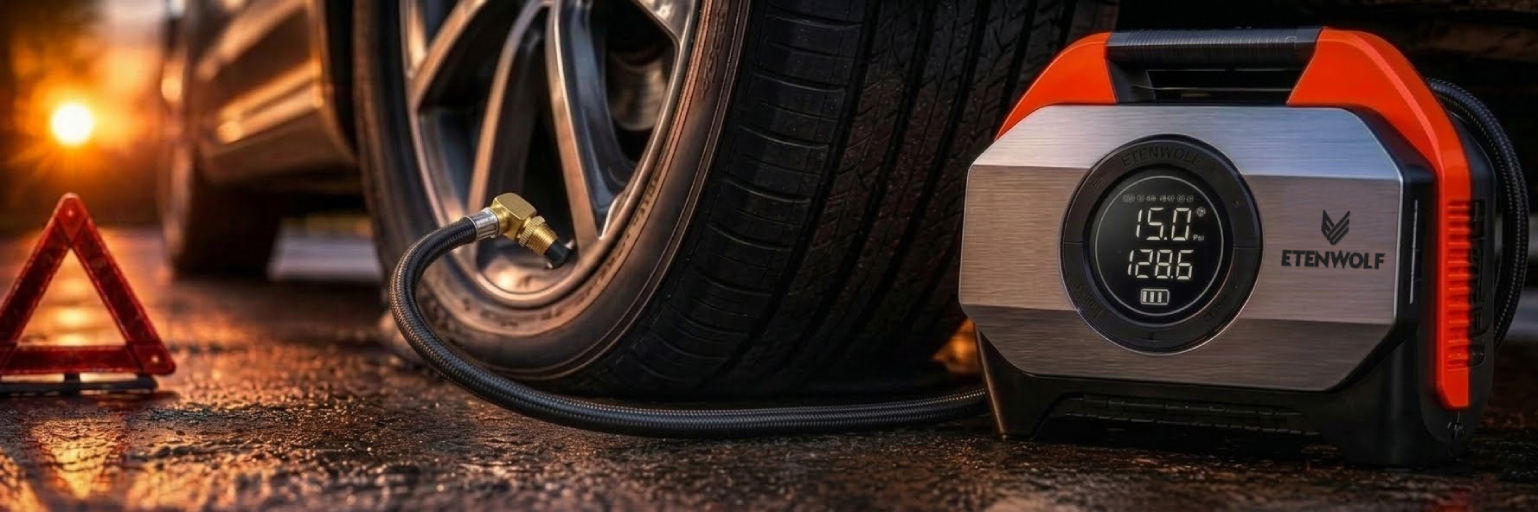

When a tire suddenly leaks or blows out, the first priority is to stop safely: turn on the double flashers, hold the steering wheel tightly, slow down slowly, and drive the vehicle off the main road to a flat and safe location. Assess the tire condition after parking: If the tire leaks slowly (tire pressure is above 15-20 PSI), you can use a portable air pump to temporarily inflate it to a safe driving pressure (at least 25 PSI), and then drive to the nearest repair point at low speed. If the tire is punctured or completely flat, replace the spare tire or call roadside assistance.
A flat tire is when the air inside the tire is lost at an abnormal rate. According to the air leakage speed, it can be divided into:
Slow Air Leak: A gradual decrease in air pressure over hours or days. Common causes include aging valves, tires punctured by small nails or screws, and a poor seal between the wheel hub and tire.
Rapid air leak: The air pressure drops significantly within a few minutes. Common causes include tires being punctured by larger, sharp objects and sidewalls being cut by curbs.
Blowout: A tire completely loses air pressure in a very short period of time (a few seconds). Common causes include serious damage to the tire sidewall, aging of the tire structure, and overheating and rupture of the sidewall caused by excessive under-pressure driving.
According to NHTSA, approximately 11,000 vehicle accidents in the United States each year are caused by flat or blown tires. Understanding the emergency inflation process can help you escape safely at critical moments.
Safe parking Operation guide
Step 1: Stop safely. Hold the steering wheel tightly, turn on the double flashers, slow down slowly, park the vehicle in a flat and safe location, tighten the handbrake, and place the warning triangle.
Step 2: Assess tire condition. Check the appearance of the tires, listen for air leakage, and measure the current air pressure with a tire pressure gauge/air pump. Use the table below to determine whether it is suitable for temporary inflation.
| Measurement results | Recommended actions |
| 25PSI or more | You can continue driving after inflating to the recommended value. |
| 15-25PSI | You can inflate to 25-30PSI and then drive to the nearest maintenance point at low speed (not exceeding 64km/h). |
| Below 15PSI | It is not recommended to continue driving, change the spare tire or call for rescue |
| Tire completely flat/sidewall touching the ground | Never drive after inflating the tire, you must replace the tire |
Step 3: Prepare the air pump. Align the air pipe connector of the air pump with the tire valve and tighten clockwise or press and lock (depending on the type of connector). Make sure the connection is tight to avoid air leakage when inflating.
Step 4: Start inflating. Start the air pump and observe the pressure gauge or digital display. During the inflation process, pay attention to monitor the air pump for abnormal noise or signs of overheating.
Step 5: Stop when the target air pressure is reached. If the air pump has an automatic shutdown function, it will automatically stop when the preset air pressure is reached. If there is no automatic shutdown function, manually turn off the air pump when the air pressure approaches the target value.
Step 6: Retest and confirm. Wait 1-2 minutes for the air pressure to equalize and retest with an independent tire pressure gauge. Confirm that the air pressure reaches above 25 PSI (minimum safe driving pressure).
Step 7: Drive at low speed to the maintenance point. Drive to the nearest tire repair point or gas station at a speed of no more than 64km/h. Pay attention to the handling feeling on the way – if the vehicle goes off track or the steering wheel shakes, stop immediately and check.
Night and highway special scenes
Emergency inflation at night:
Make sure your dual flashers are on, turn on your car lights or use a cell phone flashlight to illuminate your work area, and wear a reflective vest or light-colored clothing. Most digital air pumps come with LED lighting that illuminates the valve area. If the air pump’s display does not have a backlight, use your phone’s screen to illuminate the reading.
Highway emergency inflation:
The higher the speed on the highway, the higher the safety risk. If possible, pull off the highway to a service area or exit. If you cannot exit the highway, park in the emergency lane and wait outside the guardrail. When using an air pump on the motorway, the shorter the filling time the better: choose the most powerful air pump. After inflating to the minimum safe air pressure (25PSI), drive to the nearest exit or service area at a speed not exceeding 50mph (80km/h)
FAQ
Q: If a tire is punctured by a nail, can I still inflate it and continue driving?
A: If the nail is still in the tire and the air leakage is slow, you can inflate it and drive to the nearest repair point at low speed. But the driving distance should not exceed 16-24 kilometers. Do not pull out the nail, as the air leakage will be significantly accelerated after pulling out.
Q: What should I do if I don’t have a spare tire?
A: Many modern vehicles (especially those using run-flat tires) do not come with a spare tire. If your vehicle has run-flat tires, you can continue driving for up to 80 kilometers at a speed of no more than 50mph after the tires completely lose air pressure. If the tires are not run-flat and you do not have a spare tire, call roadside assistance.
Q: Can I inflate tires in the rain?
A: Yes, but it should be operated under the cover of a vehicle as much as possible. Rainwater entering the valve may cause the valve core to rust, increasing the risk of subsequent air leakage. After inflating, cover it with a valve cap to prevent moisture from entering.
Q: How low can the air pump be?
A: Most 12V portable air pumps can inflate a completely flat tire to a safe driving pressure, but this takes a long time (8–15 minutes) and places a heavy load on the air pump. It is recommended to choose an air pump with high power and high battery capacity.
The emergency response principle when a tire is leaking or blowing out is: first stop the vehicle safely, then evaluate the situation, and finally decide on a course of action based on the air pressure. Portable air pumps are an effective emergency tool in slow leak scenarios and can inflate tires to safe driving pressure in a short time. But temporary inflation is only a stopgap measure: going to a professional repair station as soon as possible for permanent repair is the fundamental solution. Every driver should keep a reliable air pump and tire pressure gauge in the trunk and be familiar with basic emergency inflation procedures.