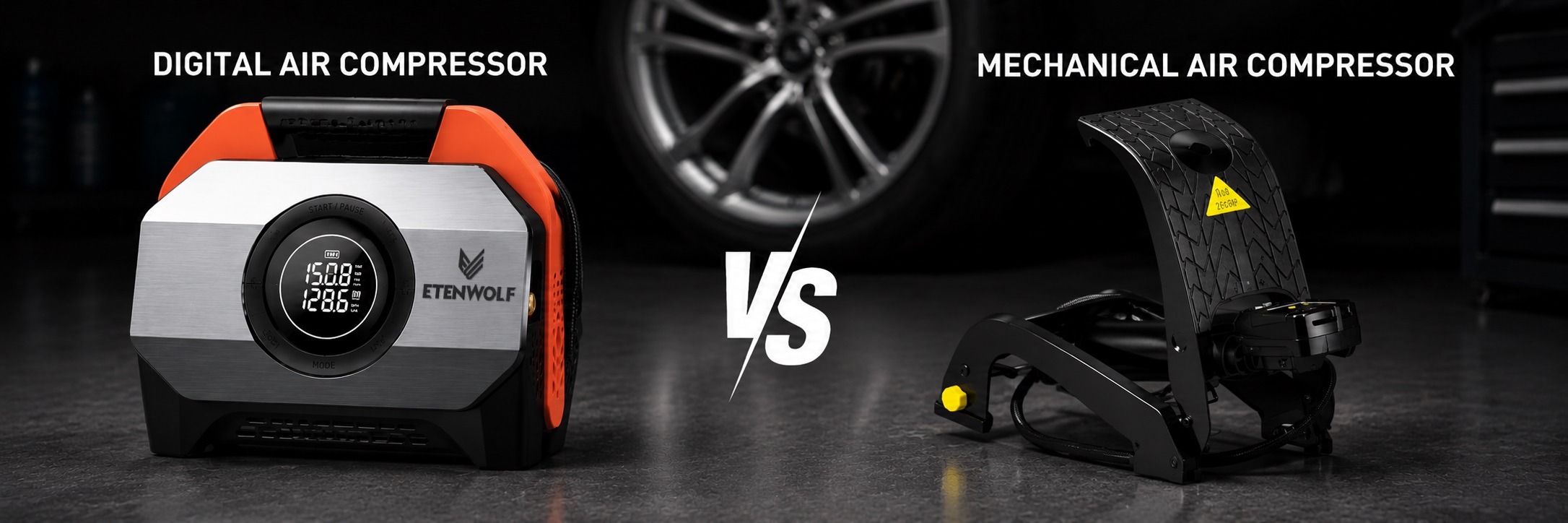

Digital air pumps are generally more accurate than mechanical air pumps. The accuracy of a reliable digital air pump can reach ±1PSI, while the accuracy of traditional pointer air pumps is usually between ±1-3PSI. The digital air pump reads data through an electronic pressure sensor, which eliminates errors caused by mechanical wear, but requires battery power. The mechanical air pump does not require a power supply and has a more durable structure, but the wear of internal components after long-term use will cause the accuracy to gradually decrease.
Digital air pumps use an electronic pressure sensor: usually a piezoresistive strain gauge sensor to measure air pressure. The sensor converts the physical pressure of the compressed air into an electrical signal, which is processed by the built-in microcontroller and displays the reading in digital form on an LCD or LED screen. Since there are no mechanical moving parts in the measuring chain, there is no loss of accuracy due to gear wear or spring fatigue.
Pointer air pumps work on a Bourdon tube mechanism. A Bourdon tube is a curved, hollow metal tube that gradually straightens due to internal pressure when compressed air enters the tube. This straightening movement is transmitted to the pointer through the gear set, causing the pointer to indicate the air pressure value on the dial. When the product is new and well calibrated, a good quality pointer air pump can achieve decent accuracy. But long-term use can cause bourdon tube metal fatigue, gear tooth surface wear, and dust and moisture entering the housing—all of which can reduce accuracy over time.
Why digital air pumps are more accurate
Digital pressure sensors measure air pressure electronically rather than through mechanical movement. The most common type of sensor used in consumer digital air pumps is a piezoresistive strain gage sensor: a very thin silicon membrane with a resistor embedded in it, which changes resistance when pressure is applied to the membrane. This change in resistance is detected by the bridge circuit and converted into a digital reading by an analog-to-digital converter.
The core advantage of this approach: No mechanical friction – no gear sets, no pointer shafts, no fatigue-causing Bourdon tubes. The only “moving parts” are the response of the microscopic silicon membrane to air pressure. Auto-Zero Calibration – Many digital air pumps perform a self-zero test every time they are powered on, resetting the reference to atmospheric pressure and eliminating accumulated offset errors. Reading resolution: The digital display can display an accuracy of 0.1 PSI, while most pointer dials only have markings at 1 or 2 PSI, making it difficult for users to accurately read the intermediate value.
Advantages of mechanical air pumps
Despite their lower accuracy, mechanical air pumps remain popular for a number of reasons: No reliance on batteries: Mechanical pointer or pen air pumps work regardless of battery status. This makes them perfect for emergency kits that sit in the glove box for months or even years without use. Digital air pumps are completely unusable when the battery is drained. Extreme Temperature Tolerance: In extremely cold environments (below 0°F/-18°C), the LCD screen responds slowly and the lithium battery output drops significantly. Mechanical pointer air pumps have no electronic components that can fail due to cold. However, the lubricating oil inside the pointer air pump may thicken at extremely low temperatures, slightly affecting the flexibility of the pointer. Resistant to physical damage: While a good quality metal-cased pointer-type inflator will still work fine after being dropped from concrete, a digital inflator unit with a fragile LCD screen and circuit board is more susceptible to damage. Cost: $10-$25 for a digital model, while a reliable digital air pump with a built-in compressor usually costs $30-$80. For users with occasional use and acceptable ±1 PSI accuracy, the mechanical option is very cost-effective.
Operation guide
Step 1: Determine your accuracy needs. If you drive an ordinary passenger car and check the tire pressure occasionally, the ±1 PSI accuracy of a high-quality pointer air pump is sufficient. If you own a performance car, a track car, or drive in extreme climates where air pressure tolerances are tighter, invest in a digital air pump with ±0.5 PSI accuracy.
Step 2: Consider the usage environment. For an emergency kit that stays in the car year-round, a mechanical pointer or pen air pump is more reliable because it doesn’t rely on batteries. For regular use around the home or garage, digital air pumps with built-in compressors offer the best combination of precision and convenience.
Step 3: Check out key features. For digital air pumps, pay attention to the following features: an automatic shutdown function to prevent overcharging, a backlit display for easy nighttime use, a pressure range of at least 0–100 PSI (compatible with all models), and an inflation nozzle with a locking function (to prevent air leakage during inflation).
Step 4: Verify before buying. Within the first week after purchasing a new pump, cross-reference its readings with a gas station inflator or a reference meter known to be accurate. If the deviation exceeds ±1 PSI, consider returning it and trying another model.
Step 5: Regular maintenance. For digital air pumps, replace batteries every year and store in a cool, dry place. For pointer-type air pumps, tap the dial before each use to release any pointers that may be stuck, and calibrate with a reference chart every 6–12 months. Any air pump that cannot be calibrated to within ±1 PSI should be replaced.
FAQ
Q: Will the accuracy of the digital air pump decrease over time?
A: The electronic pressure sensor itself is very stable, and its accuracy can be maintained for many years without degradation under normal use.
Q: How often does a mechanical air pump need to be calibrated?
A: For pointer air pumps, it is recommended to use a known and accurate reference table for comparison every 6-12 months. If the readings deviate by more than ±1 PSI, the air pump should be replaced.
Q: Does the automatic stop function affect accuracy?
A: The automatic shutdown function relies on the pressure sensor inside the air pump. Automatic shutdown can stop inflation when it is close to the target value to avoid overcharging.
Q: Can I use a car air pump to inflate motorcycle or bicycle tires?
A: Yes, provided the pressure range of the air pump covers the required value. Motorcycle tires typically require 28-42PSI, which most air pumps can cover. Road bike tires may require 80-140PSI.
Digital air pumps are significantly better in accuracy (±1PSI) than mechanical alternatives (±1-3PSI), making them the first choice for drivers who pursue precision and convenience. Mechanical air pumps, while compromising on accuracy, offer advantages in durability, no need for batteries, and cost: ideal as a back-up emergency tool. An inaccurate air pump is worse than no air pump at all: it gives you a false sense of security, while your tires are actually operating at incorrect pressure all the time.