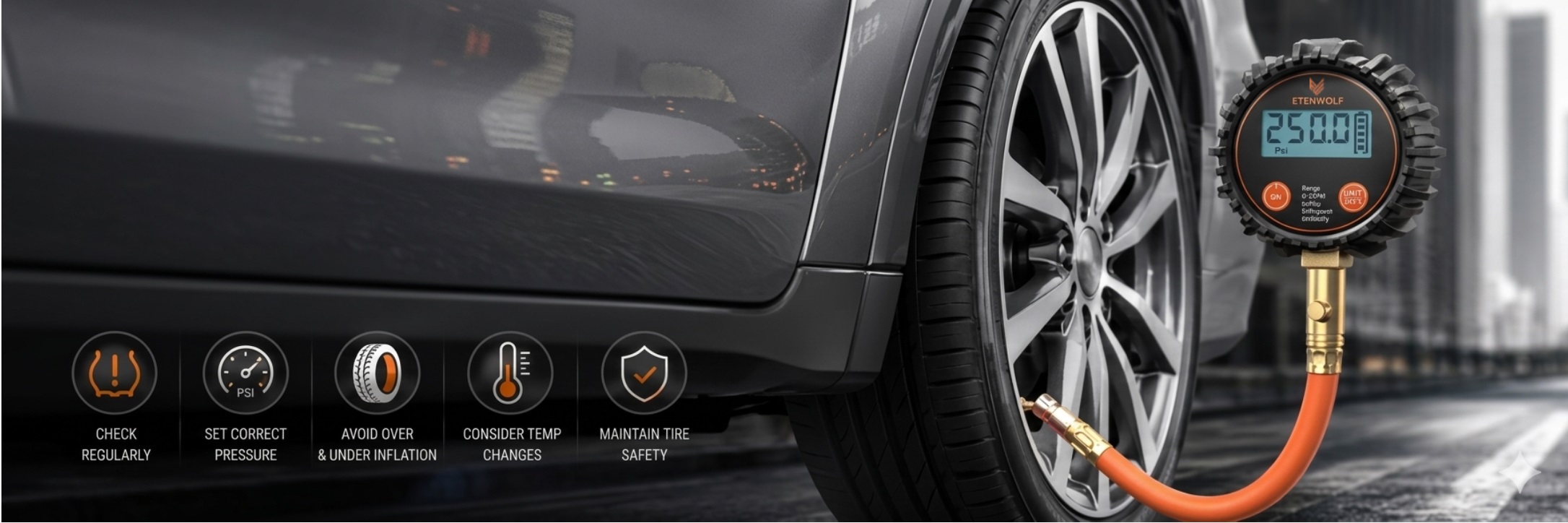

Common tire inflation errors include: not measuring and adjusting tire pressure under standard conditions, inflating to the MAX PSI marked on the tire sidewall, over-reliance on the tire pressure monitoring system (TPMS) and not manually checking tire pressure, not re-testing after inflation, and tire pressure not adjusting according to the season.
Mistake 1: not in standard case Measure and adjust tire pressure
This is the most common inflation mistake. After driving, the air temperature inside the tire increases, and the air pressure is 3-5 PSI higher than the cold tire state. If the air pressure is “adjusted” to the recommended value while the tire is hot, the actual air pressure will be 3-5 PSI lower than the recommended value when the tire cools.
Hazards: Driving in an under-pressure state for a long time will increase fuel consumption, accelerate tire wear, and increase the risk of tire blowout.
Correct approach: Measure and adjust tire pressure with cold tires (vehicle parked for more than three hours or driven no more than one mile). Never deflate a tire while it is hot. Wait until the tire cools down before testing again.
Mistake 2: Inflating the tire to the sidewall mark MAX PSI
Many people mistakenly believe that “MAX PRESS” marked on the tire sidewall is the recommended tire pressure. In reality, MAX PSI is the maximum pressure a tire can safely hold when cold and is not the vehicle manufacturer’s recommended operating pressure.
Hazards: Overcharging leads to reduced road grip, accelerated tire center wear, poor ride comfort, and increased wet braking distance.
Correct approach: Always use the recommended tire pressure on the label on the driver’s door jamb. For the detailed differences between MAX PSI and recommended values, see “PSI-Explained-What-It-Means-and-Why-It-Matters-for-Your-Tires”.
Mistake 3 : Over-reliance Tire Pressure Monitoring System (TPMS) No manual checking tire pressure
Many drivers think that the TPMS (Tire Pressure Monitoring System) warning light is the only tire pressure indicator they need to pay attention to. But TPMS usually triggers the alarm when the air pressure is 25% below the recommended value: this means that your tires may have been driving under-inflated for weeks or even months before receiving the first warning.
Hazard: Before the TPMS light comes on, the tires have been running under pressure for a long time, during which additional fuel consumption and tire wear have accumulated.
Correct approach: TPMS is a safety backup system, not a daily maintenance tool. Manually check your tire pressure at least once a month and don’t wait for the TPMS light to come on.
Mistake 4 : No further testing after inflation
Many people stop immediately after the air pump shows that the target air pressure has been reached, without retesting. But air turbulence and temperature changes during inflation can cause inaccurate readings.
Hazards: The value displayed by the air pump may deviate from the actual air pressure, causing the tire to be driven under-inflated or over-inflated without knowing it.
Correct approach: After inflation is completed, wait 1-2 minutes for the air pressure to equalize, and then retest with an independent tire pressure gauge. If the air pump has an automatic shutdown function, retest will also be performed after the shutdown.
Mistake 5 : tire pressure Does not follow seasonal adjustments
As the seasons change, changes in ambient temperature directly affect tire pressure: 1 PSI for every 10°F (5.6°C) change in temperature. From summer to winter, the air pressure of a tire may drop by 3-8 PSI (depending on the temperature difference between summer and winter).
Hazards: Low tire pressure in winter leads to reduced fuel economy, accelerated tire wear, poor handling performance, and increased risk of tire blowouts.
Correct approach: Check and adjust all tire pressures before the first cold snap. Thereafter, check once a month until the temperature stabilizes. For detailed data on the impact of temperature on tire pressure, see “How-Temperature-Affects-Tire-Pressure-The-Complete-Guide”.
Daily tire pressure operation guide
Step one: Establish correct inflation habits. Before each inflation, make sure: the tires are cold, the air pump unit is correct, and the recommended tire pressure has been confirmed.
Step 2: Inflate according to the correct process. Connect the air pump → set the target value → start inflation → the air pump automatically stops → wait for 2 minutes → retest with an independent tire pressure meter.
Step 3: Record the date, air pressure reading and ambient temperature of each inflation. This helps you spot pressure trends and potential slow leak problems.
Step 4: Seasonal adjustment. Inflate all tire pressures to the recommended upper limit when autumn and winter begin, and check whether they need to be properly deflated when spring and summer begin.
Step 5: Don’t forget the spare tire. Check the spare tire every time you check the running tires.
FAQ
Q: How often is the most reasonable time to check tire pressure?
A: At least once a month. If you find that the air pressure of a certain tire is often lower than that of other tires (a drop of 2 PSI or more per month), there may be a slow air leak and you should go to a maintenance point for inspection.
Q: My car has a TPMS, do I still need to check it manually?
A: Required. TPMS only alarms when air pressure is severely insufficient and cannot replace regular manual inspections. Manual inspection can reveal minor undervoltage issues that the TPMS cannot detect.
Q: Should the air pressure of the four tires be exactly the same?
A: For most passenger cars, the recommended air pressure for the front and rear wheels is the same or similar. However, the recommended air pressure for the rear wheels of some models (especially rear-wheel drive pickup trucks and large SUVs) is 3-5 PSI higher than that of the front wheels. Please refer to the marking on the door frame label for details.
Q: The air pressure displayed by the air pump is inconsistent with the reading of the independent tire pressure gauge. Which one should I trust?
A: If your independent tire pressure gauge is a high-precision model that is known to be accurate (±0.5 PSI), trust the tire pressure gauge’s reading. The air pump’s internal sensor may be biased. For details on how to verify the accuracy of the air pump, see Part 9 of this series “Air-Pump-Accuracy-Explained-How-to-Know-If-Your-Reading-Is-Right”.
Most tire inflation errors stem from a lack of attention to detail: hot tire measurement, reliance on TPMS, no retesting. These errors may not seem to have much impact individually, but cumulatively may cause the tire to operate at a pressure that deviates from the recommended value for a long time. Developing correct inflation habits is the simplest and most effective way to ensure driving safety, save fuel, and extend tire life.