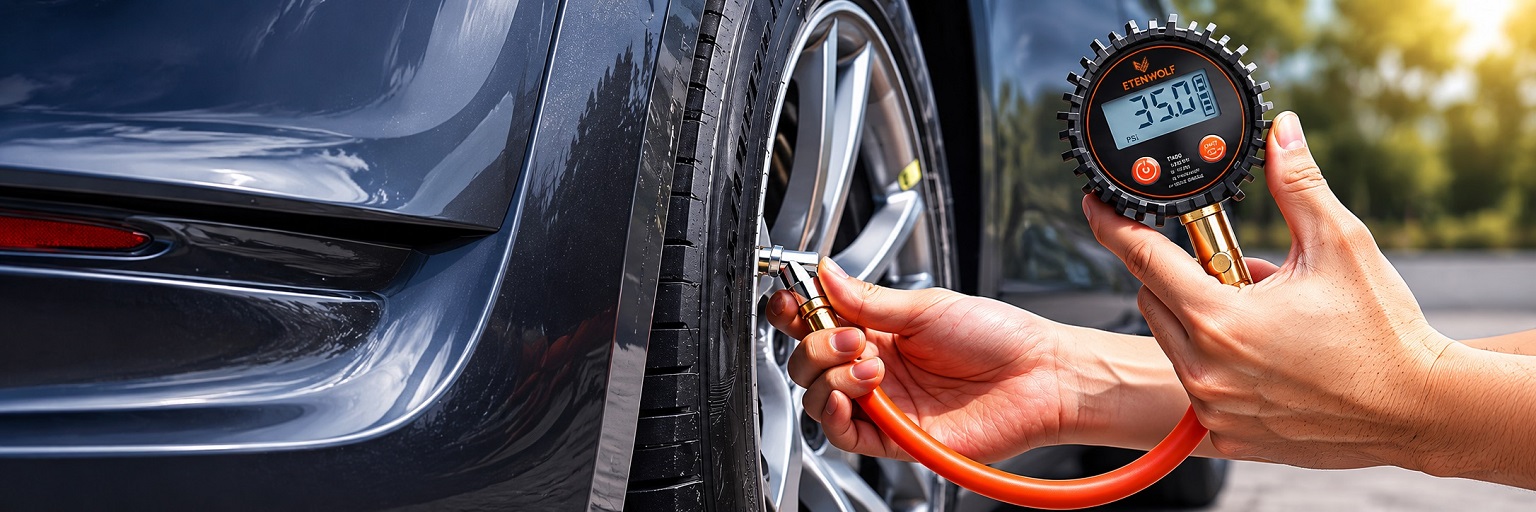

The accuracy of the air pump depends on the type of pressure sensor, manufacturing tolerances, service temperature and age. The difference of 3PSI between an air pump with ±0.5PSI accuracy and an air pump with ±1.5PSI accuracy is enough to affect fuel economy and tire wear. The easiest way to determine whether your air pump readings are trustworthy is to cross-reference them with a high-precision reference meter that is known to be accurate.
Inflation Accuracy refers to the deviation range between the reading displayed by the air pump and the actual tire pressure. Accuracy is usually expressed in the form of “±XPSI”.
Technical differences between ±0.5PSI and ±1PSI
| Accuracy level | Shows actual range at 35PSI | Deviation maximum | Percent deviation from 35PSI recommendation |
| ±0.5PSI | 34.5-35.5 | 0.5PSI | ±1.4% |
| ±1.0PSI | 34-35 | 1.0PSI | ±2.8% |
| ±1.5PSI | 33.5-36.5 | 1.5PSI | ±4.3% |
| ±2.0PSI | 33-37 | 2.0PSI | ±5.7% |
If you drive a performance car, race car, or drive in extreme climates, ±0.5 PSI accuracy is worth the investment. For ordinary family cars, the accuracy of ±1PSI is enough to meet daily needs. For a comparison of the accuracy of different air pump types, see “Digital-vs-Analog-Tire-Inflators-Which-Is-More-Accurate” for details.
Specific factors affecting accuracy
Sensor calibration status: Each air pump is calibrated at the factory, but calibration accuracy will vary over time and usage conditions.
Ambient temperature fluctuations: Because the physical characteristics of the sensor change under extreme temperatures, the accuracy will drop by 0.5-1.0 PSI. Electronic sensors generally perform better at extreme temperatures than mechanical sensors.
Frequency of use of the air pump: The accuracy of air pumps that are used frequently decreases faster. The accuracy of a mechanical air pump may decrease by 0.5-1.0 PSI after being used 500-1,000 times. Digital air pump sensors are more durable.
Air pressure range: Most air pumps are most accurate in the mid-air pressure range (25-45 PSI), with accuracy decreasing as they approach their minimum or maximum operating pressure. For example, an air pump with a maximum pressure of 160 PSI may be 0.5 PSI worse near 140 PSI than near 35 PSI.
How to tell if your air pump readings are trustworthy
Here are two simple and effective verification methods:
Method 1: CrossovercontrastLaw
With the tires cold, use your air pump to measure the air pressure in one tire and record the reading. Immediately repeat the measurement on the same tire using another high-precision reference meter that is known to be accurate (such as a digital tire pressure gauge with ±0.5 PSI accuracy) and compare the two readings. If the difference is within ±0.5 PSI, your air pump has good accuracy. Repeat this test on at least three tires to ensure consistent accuracy across different air pressure ranges.
Method 2: static test method
Use your air pump to inflate a tire to the precise target pressure (e.g. 35.0 PSI), turn off the air pump, wait 30 minutes (to ensure the tire temperature and pressure are completely stable), and re-measure the same tire. If the reading changes by more than 0.5 PSI, there may be a slow leak in the valve inside the air pump, or the sensor may be drifting.
Tire pressure detectionOperation guide
Step one: Buy a high-precision reference watch. Invest in a digital tire pressure gauge with an accuracy of ±0.5 PSI as your reference standard. This type of tire pressure gauge, which typically costs $10-$30, is the best tool for verifying the accuracy of your air pump.
Step 2: Perform an initial calibration within the first week of receiving your new air pump. Don’t assume a new air pump is accurate as labeled: verify it with a reference chart. If the deviation exceeds the marked accuracy range, consider returning it.
Step 3: Perform regular verification every 6-12 months. Compare the air pump reading to a reference chart. If the deviation exceeds 1 PSI, the air pump should be calibrated or replaced.
Step 4: Recalibrate after use in extreme temperatures. If you notice a significant difference in readings after using your air pump in high temperatures or extreme cold, perform a quick calibration.
Step 5: Record the verification data. Record the date, ambient temperature and deviation value during each calibration. This helps you track trends in the pump’s accuracy and make replacement decisions before it fails completely.
FAQ
Q: Which one has more stable accuracy, digital air pump or mechanical air pump?
A: The electronic sensor of the digital air pump has more stable accuracy and slower decay during long-term use. The accuracy of mechanical air pumps gradually decreases over time, especially with heavy use or harsh environments. But digital air pumps rely on batteries and electronic components that can malfunction in extreme environments.
Q: Are the accuracy of the air pump and the accuracy of the tire pressure gauge the same thing?
A: Not exactly the same. The accuracy of the air pump includes two aspects: the accuracy of stopping at the target air pressure when inflating (determined by the internal sensor) and the display accuracy of the air pressure reading. The accuracy of a tire pressure gauge only refers to the accuracy of the measurement reading.
Q: Is the accuracy of ±0.5PSI meaningful to ordinary drivers?
A: For most daily drivers, an accuracy of ±1PSI is sufficient. The accuracy of ±0.5 PSI is mainly meaningful for the following scenarios: performance cars and track driving, long-distance heavy-duty driving, and driving in extreme climates.
Q: My air pump is not marked with accuracy, how can I tell?
A: Most cheap air pumps are not labeled with accuracy, which means their accuracy may not be high (±1.5PSI or worse). It is recommended to use a high-precision reference table for calibration. If the calibration result deviation exceeds ±1.5 PSI, it is recommended to consider replacing an air pump with a marked accuracy.
The accuracy of the air pump directly affects the accuracy of tire pressure, which in turn affects fuel economy, tire wear and handling safety. The accuracy difference between ±0.5PSI and ±1.5PSI seems small, but at the recommended tire pressure of 35PSI, the actual deviation can reach 3PSI: equivalent to making the tire oscillate between under-inflated and normal. An accurate air pump, combined with monthly tire pressure checks, is the best combination to maintain tire health.